Setting Out
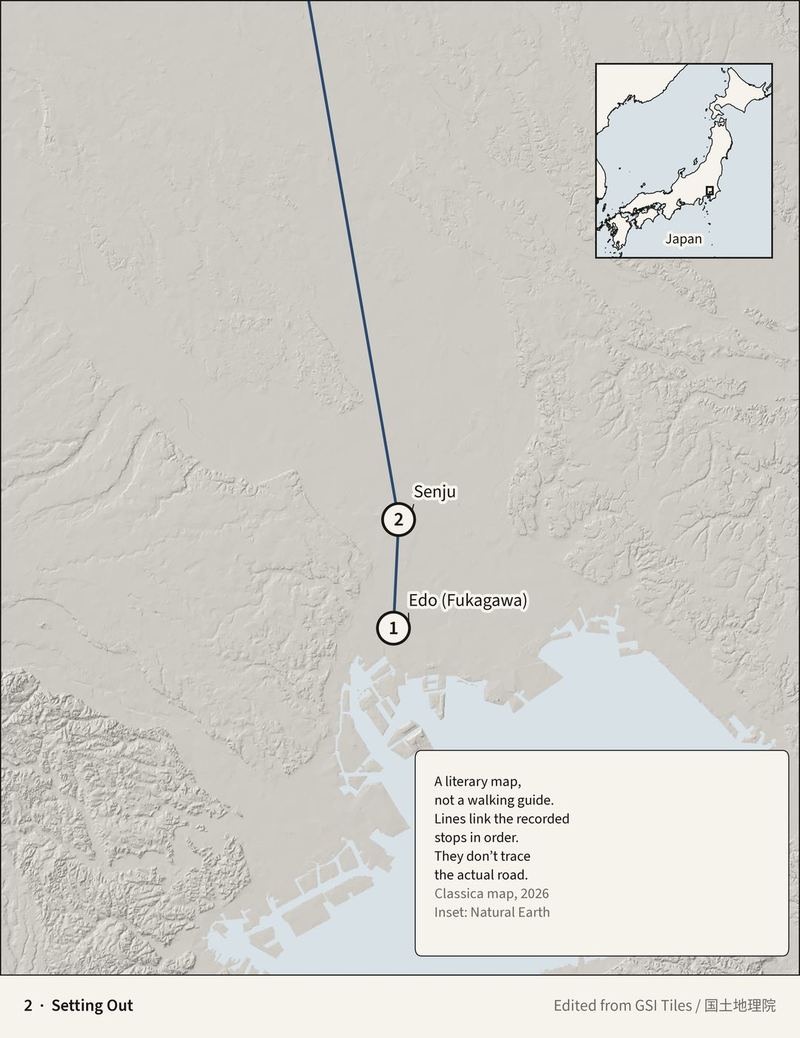
Map, Setting Out
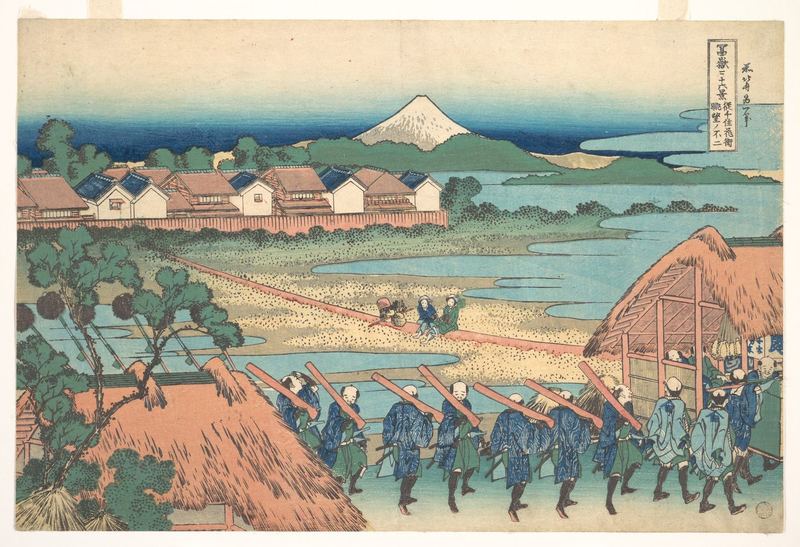
Senju, Fuji far off
It was the twenty-seventh of the Third Month. The dawn sky was soft with haze; the moon, lingering into daybreak, had dimmed its light, yet the peak of Fuji showed faintly in the distance, and the cherry boughs of Ueno and Yanaka left me wondering, with a sinking heart, when I would see them again. My closest friends had gathered the night before, and they came along on the boat to see me off. We went ashore at a place called Senju, and the thought of three thousand leagues ahead pressed hard against my chest. At this crossroads of a dream-like world I shed tears of parting.
Departing spring—birds cry out, and the eyesof fish are wet with tears
I took this as the first poem from my traveling brush-case, and still my steps would not hurry along the road. My friends stood in a row by the wayside, meaning, it seemed, to watch until our backs were out of sight.
Traveler’s notes
彌生も末の七日: the 27th of the Third Month, late spring. Lunar months are kept as they are. 在明 is the waning moon still up at dawn; 朧々 (haze) and 花 (cherry at Ueno and Yanaka) are spring markers.
不二の峯 is Fuji (not “Mount Fuji” in this section). 千じゆ is Senju, the landing where the escort turned back.
前途三千里: three thousand leagues of road ahead (里 as “league”). 幻のちまた: this world as a Buddhist crossroads of illusion.
行春や (yuku haru ya): “departing spring,” a late-spring kigo; や is the cutting word. 魚 is read uo, not sakana; 泪 is namida.
Birds crying and fish with tear-like eyes share the grief of parting and of spring’s departure. A Chinese overtone is possible; exact source uncertain.
1702 first printing
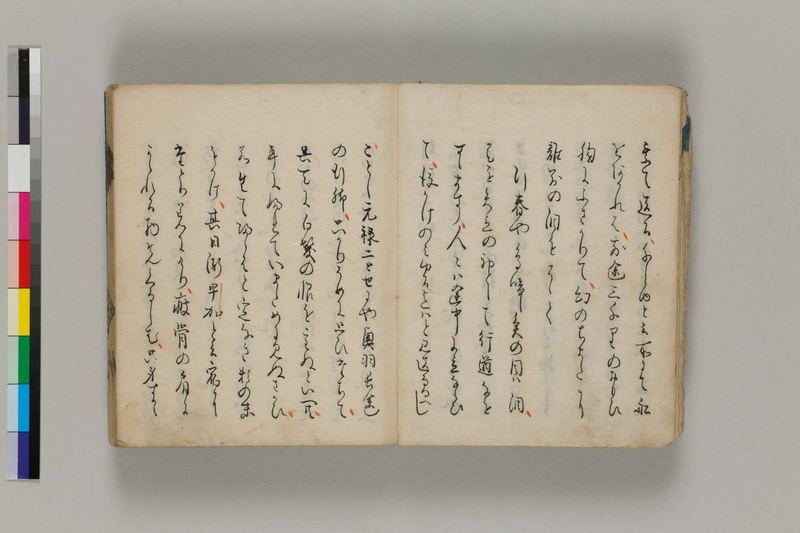
Oku no Hosomichi, 1702