Traveler’s EditionPoetry
The Narrow Road: Traveler’s Edition
おくのほそ道 (Oku no Hosomichi)
The same journey as The Narrow Road to the Deep North, in English and in the original Japanese, with maps, sketches, photographs, period pictures, traveler’s notes and Riichi’s commentary beside the text.
Bashō walked north with Sora in 1689 and wrote the road in prose and haiku. This Traveler’s Edition keeps that text and adds what the full edition gathers around it: a map for each section, an opening sketch or picture, the lines marked by the way, notes on the words, and the 1778 commentary of Takahashi Riichi where the wording has been checked. Period pictures from the 1702 printing, the 1778 commentary, Chōmu’s illustrated life and a 1913 photograph album sit with the sections and in galleries of their own.
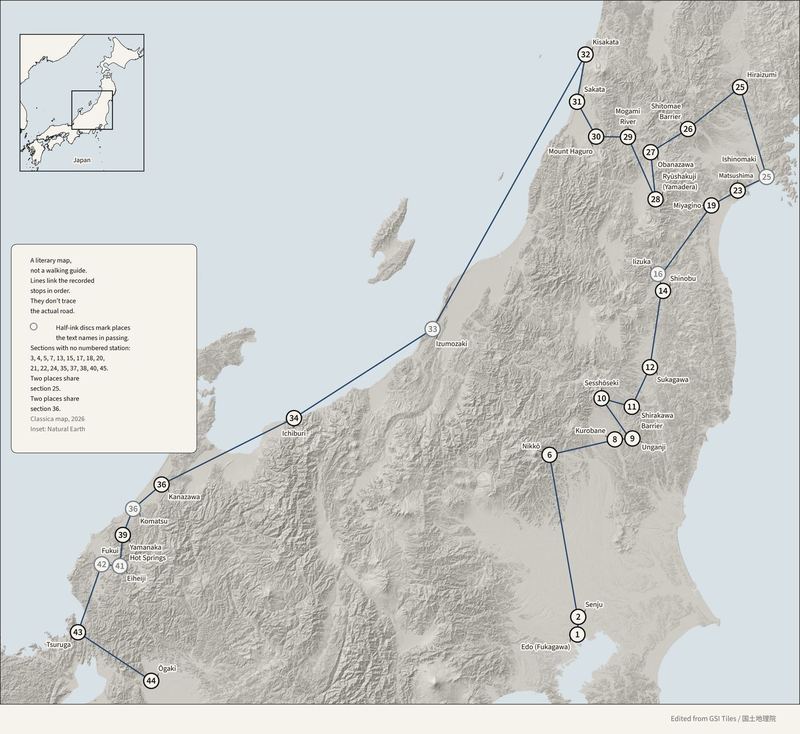
The route
Sections
- PrologueBashō opens with the thought that the months and years are travelers too. Restless after a winter at home, he mends his gear, dreams of the moon over Matsushima, gives up his hut to a new family and moves out, leaving a poem about festival dolls behind.
- Setting OutOn the twenty-seventh day of the Third Month, Bashō leaves by boat with friends who come to see him off. At Senju he steps ashore, weeps at the long road ahead, writes the first poem of the journey and walks on while his friends watch him go.
- SōkaBashō wonders whether he will ever come home from the far north, and reaches the post town of Sōka on the first day. His shoulders ache under the gear and farewell gifts he could not bring himself to leave behind.
- Muro no YashimaAt the shrine of Muro no Yashima, his companion Sora tells the story of the goddess who gave birth inside a burning chamber, which explains why poets write of smoke here. A local rule also forbids a certain fish.
- Buddha GozaemonAt the foot of Mount Nikkō, Bashō lodges with an innkeeper who calls himself Buddha Gozaemon because he is honest in everything. Bashō watches him and decides that his plain, stubborn honesty deserves deep respect.
- NikkōBashō worships at Nikkō and praises its sacred light. Sora writes a poem about shaving his head for the journey, and Bashō explains who Sora is. They visit a waterfall that can be seen from behind, where Bashō begins a summer retreat.
- Nasu MoorLost on the moor of Nasu in the rain, the travelers are lent a horse by a kind grass-cutter. Two children run behind it, and a little girl named Kasane inspires a poem by Sora. They send the horse back with its fee tied to the saddle.
- KurobaneAt Kurobane the castle steward and his brother look after the travelers for days. Bashō visits an old dog-shooting ground, a legendary grave mound and the Hachiman Shrine linked to a famous archer, and bows before the tall clogs of a mountain ascetic.
- Unganji TempleBashō climbs to the mountain retreat of the priest Butchō behind Unganji Temple, in cheerful company. He finds the tiny hut still standing against a cave on a rock, and leaves a poem about woodpeckers sparing it.
- The Killing Stone and the Wanderer’s WillowOn horseback, Bashō writes a poem for the man leading his horse. He sees the poisonous Killing Stone, ringed with dead insects, and at last stands in the shade of the willow made famous by an old poem, while a rice field is planted around him.
- The Shirakawa BarrierCrossing the Shirakawa Barrier, the gateway to the north, Bashō’s restless heart finally settles. He thinks of the poets who passed this way before him, and Sora writes that deutzia flowers in his hair must serve as his best clothes.
- SukagawaBashō crosses the Abukuma River and stays several days at Sukagawa with a friend, who asks what he wrote at the Barrier. They make linked verse together, and Bashō writes about a monk who lives under a chestnut tree.
- Asaka MarshNear Mount Asaka the travelers search the marshes for the flowering katsumi plant known from old poems, but nobody can tell them which plant it is. They pass the cave of Kurozuka and spend the night at Fukushima.
- Shinobu VillageAt Shinobu, village children show Bashō the stone once used to make a famous dye print, now lying face down in a valley. They explain that villagers pushed it there after passers-by spoiled the barley by trying it out.
- The Old Seat of Satō the StewardAt the old home of Satō the Steward, Bashō weeps over the gravestones of two brave young widows. In a nearby temple he sees the sword of Yoshitsune and the pack-basket of Benkei, and writes a poem for the Fifth Month festival.
- IizukaIn a poor house at Iizuka, rain leaks through the roof, fleas and mosquitoes bite, and Bashō falls ill. In the morning he resolves that if he dies on the road it will be heaven’s will, takes heart and walks on.
- KasashimaIn the rainy season, worn out and with the road deep in mud, Bashō cannot visit the grave of the poet-courtier Sanekata. He looks toward it from afar, writes a poem about the place name Kasashima, and stays at Iwanuma.
- The Takekuma PineBashō marvels at the Takekuma Pine with its double trunk, cut down and replanted over the centuries. He recalls an old poem saying no trace of it was left, and answers a friend’s farewell verse with one of his own.
- MiyaginoIn Sendai a local painter guides the travelers to famous old places on Miyagino Moor and beyond, then gives them pictures of the coast and sandals with blue cords. Bashō is moved and writes that he will wear the cords as his iris for the day.
- The Tsubo StoneBashō sees the ancient Tsubo Stone at Taga Castle, its inscription recording when the fort was built and rebuilt. While most famous places have vanished with time, this memorial survives, and he nearly weeps with joy.
- Sue no MatsuyamaAt Sue no Matsuyama, graves fill the spaces between the pines and Bashō thinks of lovers’ vows ending here. He hears the evening bell over Shiogama Bay, watches fishermen dividing their catch, and listens to a blind monk chant country ballads.
- ShiogamaBashō worships at the restored Shiogama Shrine. An old iron lantern given five hundred years before by the loyal warrior Izumi no Saburō makes him reflect on how a good name lasts.
- MatsushimaBashō crosses by boat to Matsushima, the islands he has longed to see. He describes them as beyond words, visits a hermit’s old retreat and spends a wonderful night by the water. Sora writes a poem; Bashō cannot sleep or write one.
- Zuiganji TempleBashō visits Zuiganji, the great Zen temple of Matsushima, and recounts how it was founded and later rebuilt by Zen Master Ungo into a splendid house of worship.
- HiraizumiLosing their way, the travelers reach Hiraizumi, where the Fujiwara lords and the warriors of Yoshitsune once held out. Bashō sits weeping on the old battlefield and writes his famous poem on summer grass. He sees the Radiant Hall, protected by a later roof.
- The Shitomae BarrierAt the Shitomae Barrier the travelers are eyed with suspicion. Rain keeps them in a border warden’s house with fleas, lice and a horse beside the pillow. A young guide with a sword then leads them safely through dark, dangerous mountains.
- ObanazawaAt Obanazawa a wealthy, generous man named Seifū welcomes the weary travelers and makes them feel at home. Bashō writes poems about the cool of the house, a toad, and the safflowers grown for dye.
- Ryūshakuji TempleBashō turns back from Obanazawa to see Ryūshakuji, a quiet temple built on a rocky mountain. He climbs to the halls on the summit and writes his famous poem about the voice of cicadas soaking into the rock.
- The Mogami RiverAt Ōishida, Bashō leaves a sequence of linked verse with local poets who have no teacher. He then rides a boat down the swift Mogami River, swollen with the summer rains, past waterfalls and steep banks.
- Mount HaguroBashō climbs the three sacred mountains of Dewa, Haguro, Gassan and Yudono. He sleeps on the snowy summit of Gassan, admires a late cherry still in bud, and keeps the secrets of Yudono as the ascetics require.
- SakataThe travelers stay at Tsurugaoka and then Sakata, by the mouth of the Mogami. Bashō writes of the cool evening along the coast, and of the river pouring the whole hot day into the sea.
- KisakataBashō reaches the bay of Kisakata in the rain and sees it the next morning in sunshine. He compares it with Matsushima: one seems to laugh, the other to grieve. Sora and a merchant add their own poems.
- The Echigo RoadThe road along the Sea of Japan coast tires Bashō and makes him ill, so he records almost nothing. He writes two poems of the Seventh Month, one of them on the River of Heaven stretching over the island of Sado.
- IchiburiAt an inn at Ichiburi, Bashō overhears two young courtesans on pilgrimage lamenting their lives. In the morning they beg to follow him, but he gently refuses, and the encounter stays with him.
- Into KagaThe travelers ford the many channels of the Kurobe River. Warned off a side trip to see wisteria, they push on through the fields of early rice into the province of Kaga, with the sea on their right.
- KanazawaAt Kanazawa, Bashō learns that a young local poet has died, and writes a grieving poem for the memorial. He also writes verses at a friend’s hut, on the road, and at a place called Komatsu.
- Ōta ShrineAt the Ōta Shrine, Bashō sees the helmet and robe of the old warrior Sanemori, who died in battle. Moved by his story, he writes a poem about a cricket under the helmet.
- NataOn the way to the hot springs, Bashō visits Nata, a temple of Kannon set among strange rocks and old pines, and writes that its autumn wind is whiter than the rocks of Ishiyama.
- Yamanaka Hot SpringsAt the hot springs of Yamanaka, Bashō stays with a boy whose village once put a famous poet to shame in his youth. Sora falls ill and leaves for Ise with a parting poem, and Bashō feels like a wild duck separated from its mate.
- Zenshōji TempleAt Zenshōji, a night behind Sora, Bashō finds Sora’s poem and listens to the autumn wind. As he leaves in the morning, young monks run after him for a poem, and he writes about sweeping the willow leaves from the garden.
- The Shiogoshi Pine, Tenryūji, EiheijiBashō sees the Shiogoshi Pine, already perfectly described in an old poem. He parts sadly from a poet friend who has walked with him from Kanazawa, and visits Eiheiji, the temple founded by Zen Master Dōgen.
- FukuiIn Fukui, Bashō looks for an old acquaintance he has not seen for ten years and finds him still alive in a little house overgrown with vines. His friend sets off cheerfully with him to guide him to Tsuruga.
- TsurugaAt Tsuruga, Bashō visits the Kehi Shrine by moonlight, but rain hides the harvest moon the next night. He then sails out to a lonely beach to gather little masuho shells and writes poems about its autumn loneliness.
- ŌgakiAt Ōgaki, friends and Sora gather around Bashō, glad to see him safe, as though he had returned from the dead. But before long he boards a boat again, this time heading for the shrines at Ise.
- Afterword by SoryūIn an afterword dated 1694, the calligrapher Soryū, who made the fair copy, praises the book’s range of feeling. He writes that it makes readers want to set out on the road themselves, and grieves that its author looks so frail.
Japanese: Prologue Setting Out Sōka Muro no Yashima Buddha Gozaemon Nikkō Nasu Moor Kurobane Unganji Temple The Killing Stone and the Wanderer’s Willow The Shirakawa Barrier Sukagawa Asaka Marsh Shinobu Village The Old Seat of Satō the Steward Iizuka Kasashima The Takekuma Pine Miyagino The Tsubo Stone Sue no Matsuyama Shiogama Matsushima Zuiganji Temple Hiraizumi The Shitomae Barrier Obanazawa Ryūshakuji Temple The Mogami River Mount Haguro Sakata Kisakata The Echigo Road Ichiburi Into Kaga Kanazawa Ōta Shrine Nata Yamanaka Hot Springs Zenshōji Temple The Shiogoshi Pine, Tenryūji, Eiheiji Fukui Tsuruga Ōgaki Afterword by Soryū