The Killing Stone and the Wanderer’s Willow
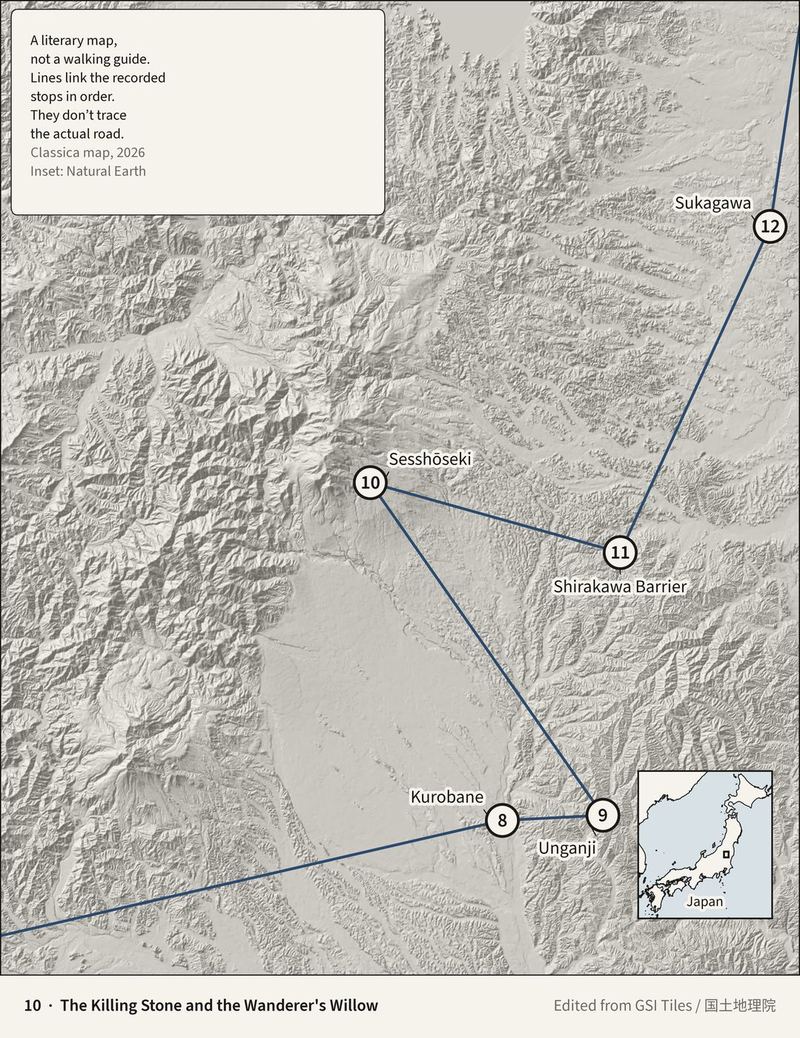
Map, The Killing Stone and the Wanderer’s Willow
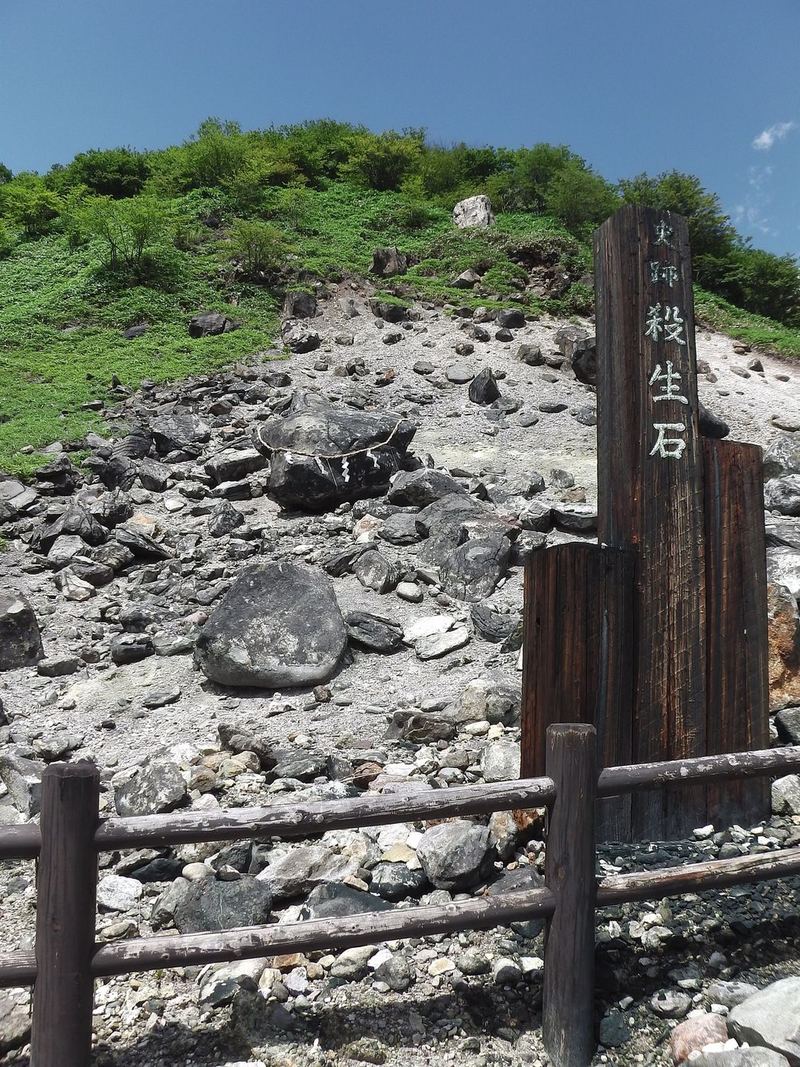
The Killing Stone, Nasu
From here we went on to the Killing Stone. The castle steward sent us there on horseback. The man leading the horse asked me to write him a poem on a slip of paper. A refined thing to ask for, I thought, and wrote:
Turn the horse aside,lead it out across the moor—the cuckoo calling
The Killing Stone lies in the shadow of a mountain where hot springs come out. The stone’s poison has still not died away; bees, butterflies, and other insects lay dead in heaps so thick that the color of the sand beneath could not be seen.
The willow “where clear water flows” stands in the village of Ashino, and it still remains on a ridge between the rice fields. The lord of this district, an officer of the Ministry of Popular Affairs, had often told me, “I would like to show you that willow,” and I had wondered where it might be. Today, at last, I came and stood in its shade.
A whole field plantedbefore I leave its shade—the willow tree
Traveler’s notes
殺生石 (the Killing Stone) lies in the shadow of a hot-spring mountain on Nasu Moor. It is the transformed body of Lady Tamamo (whose grave mound appears in the Kurobane section). Its fumes still kill bees, butterflies, and other insects, heaped so thick the sand cannot be seen.
The man leading the horse (口付のおのこ) asks for a 短册 (a poem on a slip of paper).
野を横に馬牽むけよほとゝぎす: ほとゝぎす (hototogisu) is a summer kigo; 牽むけよ is an imperative, “pull and turn [the horse].”
清水ながるゝの柳, the willow “where clear water flows,” stands at 蘆野 (Ashino). It is the Wanderer’s Willow (遊行柳) and recalls Saigyō’s poem of stopping a while in that willow’s shade beside running water.
田一枚植て立去る柳かな: he stays so long that a whole rice plot is planted before he leaves. Rice-planting is a summer kigo; かな is the cutting word. “Shade” is in the prose (and in Saigyō), not in the hokku itself.
郡守戸部某: the lord of this district, an officer of the Ministry of Popular Affairs (戸部 = 民部), who had often wished to show Bashō the willow.
1702 first printing
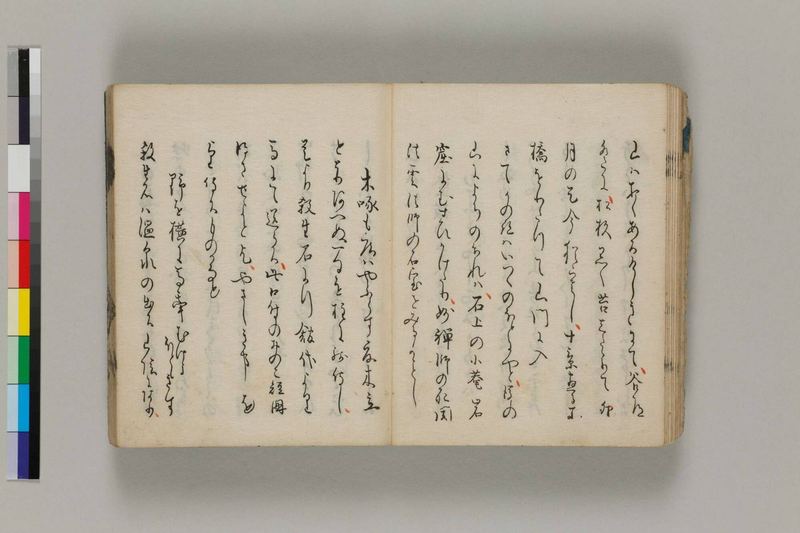
Oku no Hosomichi, 1702