Tsuruga
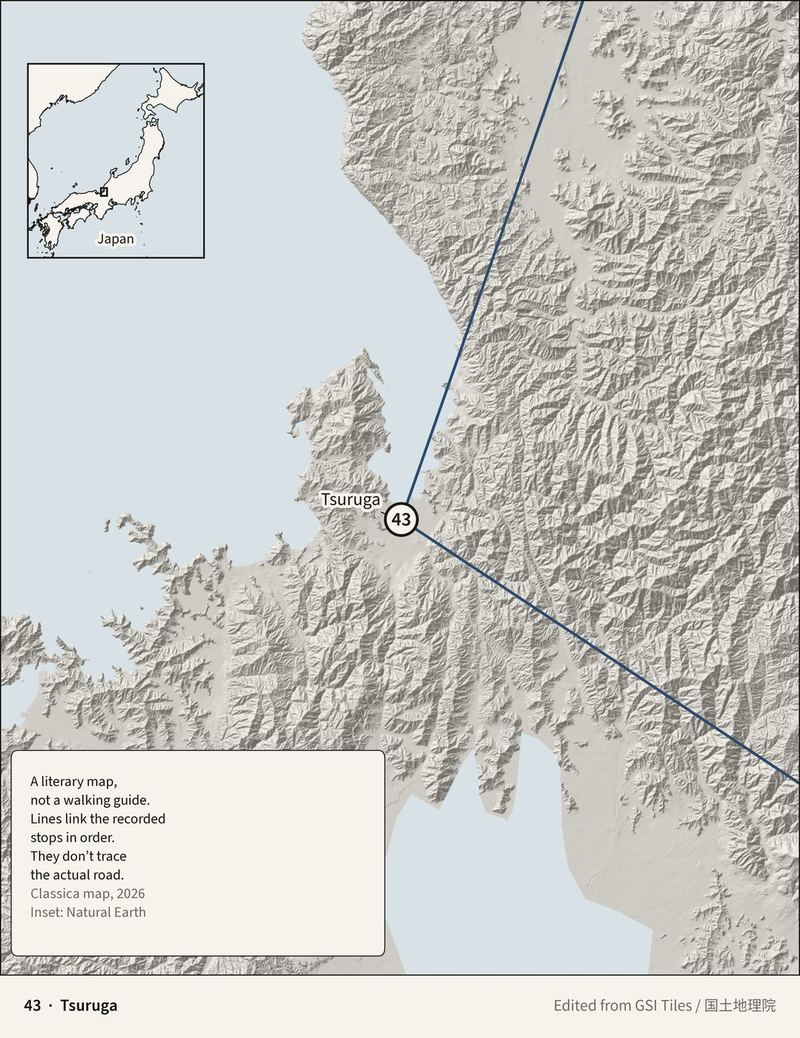
Map, Tsuruga
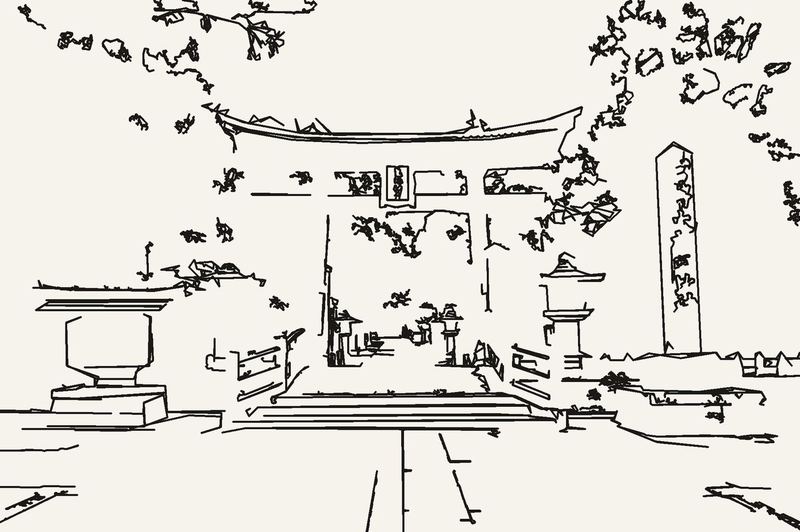
Kehi Shrine, Tsuruga
Little by little the peak of Shirane fell from sight and Mount Hina came into view. We crossed the bridge at Asamuzu, and the reeds of Tamae were already in plume. We passed the Uguisu Barrier and crossed Yunoo Pass, and at Hiuchi Castle and at Kaeruyama we heard the first wild geese. On the evening of the fourteenth we found lodging in the harbor town of Tsuruga. That night the moon was especially clear. “Will it be like this tomorrow night too?” I asked. “That is the way of the northern road: you can never tell whether the next night will be clear or cloudy,” came the answer. The innkeeper urged sake on us, and then we went by night to worship at the Kehi Shrine. It is the tomb of Emperor Chūai. The shrine had a solemn, ancient air, and where moonlight filtered in between the pines, the white sand before the sanctuary lay like a covering of frost. Long ago the second abbot of the Yugyō line made a great vow. He cut the grass himself and carried earth and stones and dried out the marshes, so that pilgrims coming and going had no more trouble. The old custom has never died out, and still today the abbot carries sand to the front of the shrine. “We call it the Yugyō sand-carrying,” the innkeeper told us.
The moon is clearon the sand the holy wanderercarried here
On the fifteenth, just as the innkeeper had said, it rained.
The harvest moon—in the northern lands the weathercannot be counted on
On the sixteenth the sky cleared, so we sailed out to Iro Beach to gather the little masuho shells. It was seven leagues across the water. A man named Ten’ya had lunch boxes and bamboo flasks of sake carefully prepared, and took many servants aboard with us, and a fair wind carried us there in no time. The beach had only a few little fishermen’s huts and a forlorn Lotus-sect temple. There we drank tea and warmed sake, and the loneliness of the evening was more than I could bear.
Loneliness—lonelier even than Suma,this beach in autumn
Between the waves—mixed in among the small shells,bits of bush clover
I had Tōsai write out an account of the day and left it at the temple.
Traveler’s notes
The peak of Shirane falls from sight and Mount Hina (比那が嵩) appears. They cross the bridge at Asamuzu (あさむづ); the reeds of Tamae (玉江) are in plume. Past the Uguisu Barrier (鶯の關) and Yunoo Pass (湯尾峠), at Hiuchi Castle (燧が城) and Kaeruyama (かへるやま) they hear the first wild geese. On the evening of the fourteenth they lodge at Tsuruga.
The moon is especially clear. Will tomorrow be the same? The innkeeper says that on the northern road you can never tell. They are urged to drink, then go by night to the Kehi Shrine (けいの明神), the tomb of Emperor Chūai (仲哀天皇). Moonlight through the pines lies on the white sand like frost.
Long ago the second abbot of the Yugyō line (遊行二世の上人) made a great vow, cut grass, carried earth and stones, and dried the marshes for pilgrims. The custom continues; the abbot still carries sand to the shrine. Only the last sentence is the innkeeper’s spoken words: “We call it the Yugyō sand-carrying.” 月清し / 遊行のもてる / 砂の上: the moon is clear on the sand that holy wanderer carried.
On the fifteenth, as the innkeeper had said, it rains. 名月や / 北國日和 / 定なき: the harvest moon (名月); in the northern lands the weather cannot be counted on.
On the sixteenth they sail seven leagues to Iro Beach (種の濱) to gather the little masuho shells (ますほの小貝). Ten’ya (天屋何某) has lunch boxes and bamboo flasks prepared. The beach has a few fishermen’s huts and a forlorn Lotus-sect temple (法花寺).
寂しさや / 須广にかちたる / 濱の秋: lonelier even than Suma (須广). 浪の間や / 小貝にまじる / 萩の塵: between the waves, bits of bush clover mixed with the small shells. Tōsai writes out an account of the day, left at the temple.
1702 first printing
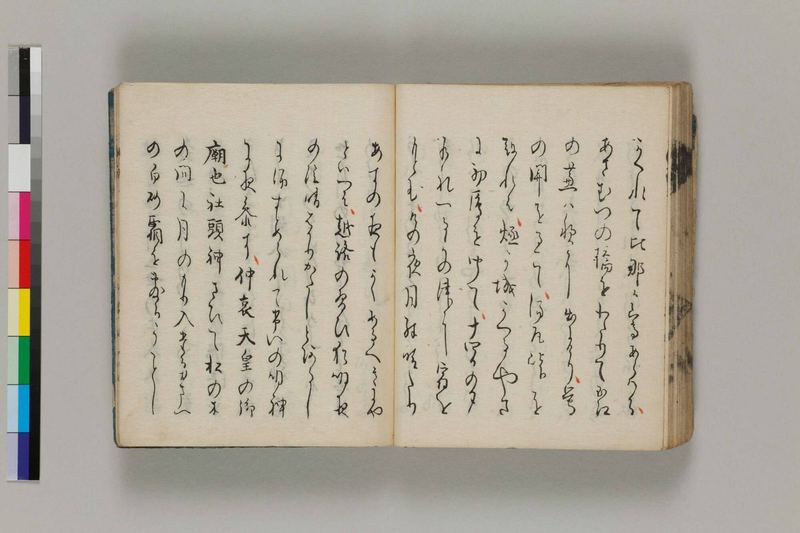
Oku no Hosomichi, 1702