Miyagino
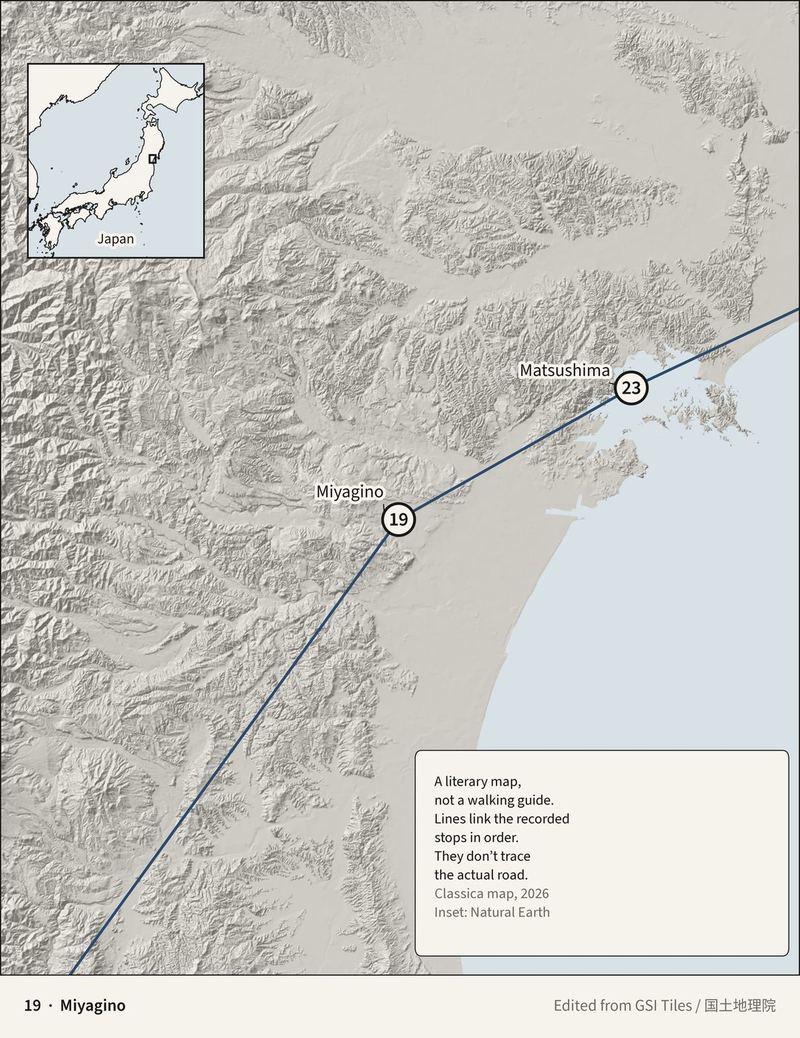
Map, Miyagino
Miyagino, Sendai
We crossed the Natori River and entered Sendai. It was the day when people lay iris leaves on their eaves. We found lodging at an inn and stayed four or five days. There was a painter here named Kaemon. I had heard he was a man of some feeling for such things, and we became acquainted. He told us that for years he had been working out the sites of famous places whose locations had grown uncertain, and he spent a day showing us around.
On Miyagino the bush clover grew thick, and I could imagine how the moor would look in autumn. At Tamada, Yokono, and Tsutsuji-ga-oka the andromeda was in bloom. We went into a pine wood where not a ray of sunlight came through; this place, they say, is called Ko-no-shita, “Beneath the Trees.” It must have been just as heavy with dew in the old days, for someone to have written, “Attendants, bid your lord put on his hat.” We paid our respects at the Hall of Yakushi, the Healing Buddha, and at the Tenjin Shrine and elsewhere, and so the day ended.
On top of this, he drew pictures of places around Matsushima and Shiogama and gave them to us, and as a parting gift he gave us two pairs of straw sandals with cords dyed deep blue. Just so: here, at the last, this man so possessed by poetic taste showed his true worth.
Sandal cords of blue—I’ll bind them to my feetas this day’s iris
Traveler’s notes
They cross the Natori River into Sendai on あやめふく日, the day people lay iris or sweet flag (あやめ) on their eaves for the Fifth-Month festival.
The painter Kaemon (畫工加右衞門), “a man possessed by poetic taste” (風流のしれもの), spends a day guiding them to places whose sites had grown uncertain.
Miyagino’s bush clover (萩) makes Bashō imagine autumn. Tamada, Yokono, and Tsutsuji-ga-oka have andromeda (あせび) in bloom. Ko-no-shita, “Beneath the Trees,” is so dewy that an old poem says “Attendants, bid your lord put on his hat” (みさぶらひみかさ): the dew under Miyagino’s trees is heavier than rain.
Kaemon gives them drawings of Matsushima and Shiogama, and two pairs of straw sandals with cords dyed deep blue (紺の染緒).
あやめ草 / 足に結ん / 草鞋の緒: he will bind the sandal cords to his feet as this day’s iris (the sweet flag of the festival). 結ん is read musuban, “I shall bind.” The verse itself does not say “blue”; that color is in the prose.
Riichi’s 1778 notes
He had ten-token sedge mats (十符の菅菰) prepared and gave them as a parting gift, it is said.
The Narrow Road is a famous place, and so the village of Tofu (十符乃里) is a name 〓. … There is a foundation poem 〓 of the ten-token sedge mats 〓. …
1702 first printing
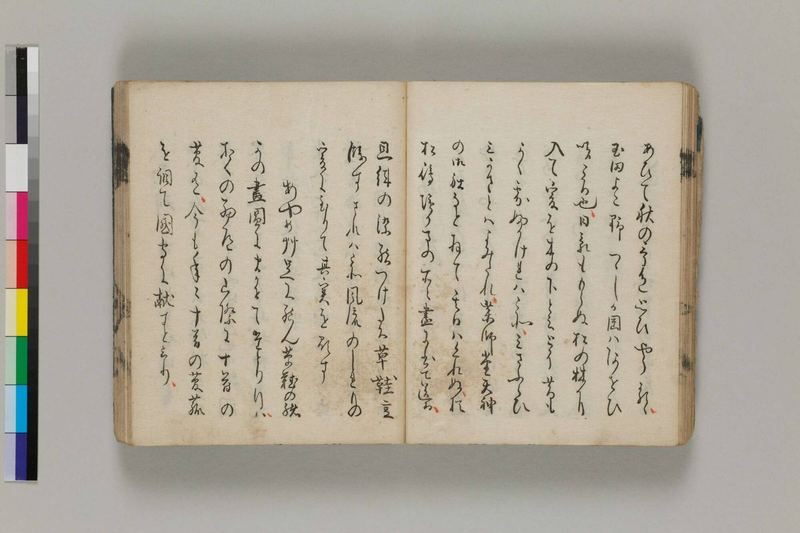
Oku no Hosomichi, 1702