Kisakata
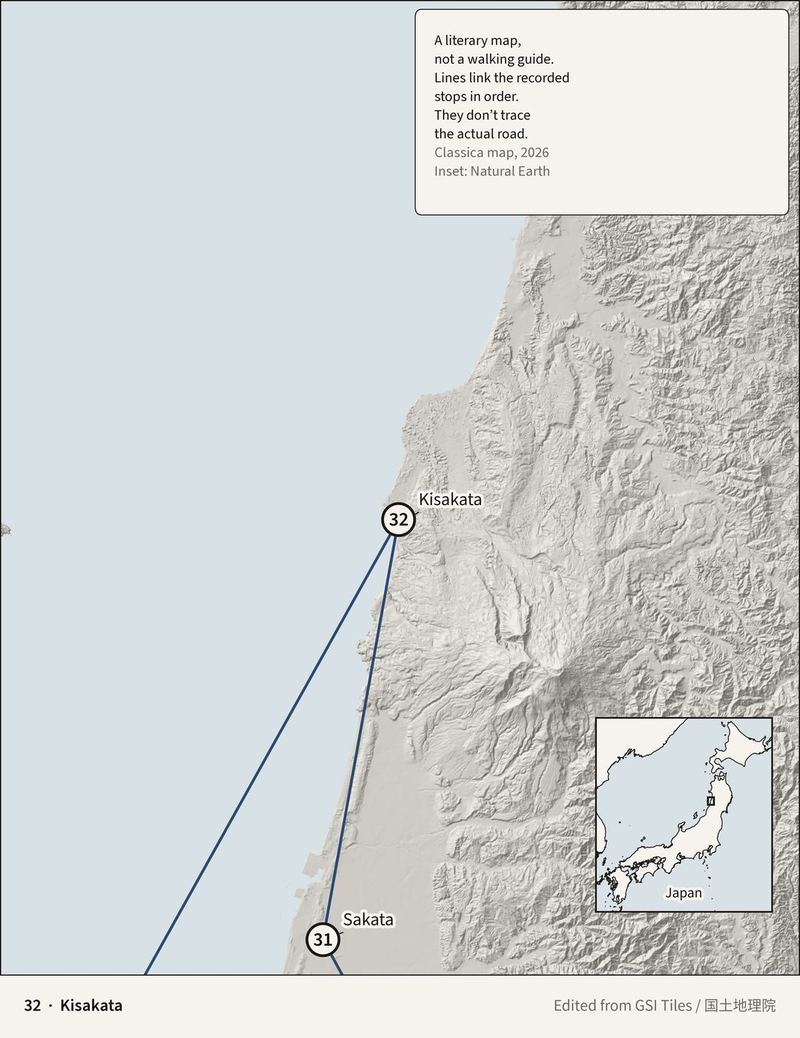
Map, Kisakata
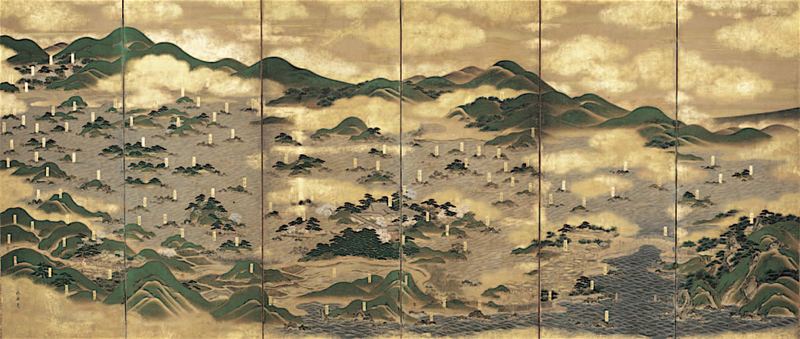
Kisakata Bay
By the way
The bay Bashō saw is dry land now. On 10 July 1804 an earthquake lifted the lagoon floor, and the old islands stand among rice fields.
I had seen river and mountain, sea and land, every kind of beauty, and now my heart was pressing me on toward Kisakata. From the port of Sakata we went northeast, over hills, along the rocky shore, treading the sand, some ten leagues in all. As the sun began to lean, a sea wind blew the sand up into the air, and in a haze of rain Mount Chōkai was hidden. Groping along in the dark, I told myself that if rain, too, has its wonder, then the clear weather after rain promises still more, and I squeezed into a fisherman’s rush-matted hut to wait for the rain to lift.
The next morning the sky cleared beautifully, and as the morning sun came out bright we set a boat out on Kisakata. First we put in at Nōin Island and visited the remains of the place where he lived in seclusion for three years. Then we landed on the far shore, where an old cherry tree, the one of the poem that speaks of rowing over the blossoms, remains as a keepsake of the priest Saigyō. By the water there is an imperial tomb, said to be the grave of the Empress Jingū. The temple is called Kanmanjuji. I have never heard that she came here. How can that be? When I sat in the abbot’s quarters of this temple and rolled up the blinds, the whole scene lay within one sweep of the eye. To the south Mount Chōkai holds up the sky, and its reflection lies in the bay. To the west the view ends at the road to the Muyamuya Barrier; to the east a causeway has been built, and the road to Akita runs far along it. To the north the sea stands guard, and the place where the waves come breaking in is called Shiogoshi. The bay is about a league long and a league wide. In its look it recalls Matsushima, yet it is different. Matsushima has the air of laughter; Kisakata, of grief and grievance. Loneliness with sorrow added to it: the lie of the land seems to trouble the soul.
Kisakata—Xi Shi with eyes half closed in rain,the silk tree in flower
Shiogoshi—the crane’s long legs are wet,the sea is cool
At the festival
Kisakata—what is the fare they eatat the god’s festival?— Sora
The fisher’s house—laying out the shuttersto sit in the evening cool— Teiji, a merchant from Mino
Seeing an osprey’s nest on a rock
Did they make a vowthat the waves would not cross here?the osprey’s nest— Sora
Traveler’s notes
From Sakata they go some ten leagues northeast toward Kisakata. Mount Chōkai (鳥海) is hidden in blown sand and rain. 莫作 is read as 摸索 (mosaku), “groping”; they grope in the dark and wait out the rain in a fisherman’s rush hut.
In the clear morning they boat on Kisakata. First Nōin Island, where Nōin lived in seclusion for three years; then an old cherry of Saigyō’s, the tree of the poem about rowing over the blossoms (花の上こぐ). An imperial tomb is said to be Empress Jingū’s (神功后宮); Bashō has never heard that she came here. The temple is Kanmanjuji (干滿珠寺).
From the abbot’s quarters: Chōkai to the south, the Muyamuya Barrier (むやむやの關) to the west, the road to Akita on an eastern causeway, and Shiogoshi (汐ごし) to the north, where the waves come in. Matsushima is like laughter; Kisakata, like grief. Loneliness with sorrow added to it.
象潟や / 雨に西施が / ねぶの花: 西施 is read Seishi (Xi Shi). ねぶの花 is the silk tree, playing on 眠, “to sleep” — Xi Shi’s half-closed eyes in the rain. The comparison of a lake in rain to Xi Shi goes back to Su Shi on West Lake. 汐越や / 鶴はぎぬれて / 海凉し: a crane’s shanks wet, the sea cool (summer).
The headnote 祭禮 is “At the festival.” Sora’s 象潟や料理何くふ神祭 asks, playfully, what fare they eat at the god’s festival; くふ is kū, “eat.” Teiji (低耳), a merchant from Mino, writes of a fisher’s house, shutters (戸板) laid out for the evening cool; the first phrase is jiamari (ama no ie ya, six morae).
The headnote 岩上に睢鳩の巣をみる is “Seeing an osprey’s nest on a rock.” Sora’s 波こえぬ契ありてやみさごの巣 asks whether the osprey had a vow that the waves would not cross here — an echo of the lovers’ vow at Sue no Matsuyama.
Riichi’s 1778 notes
I had seen river and mountain, sea and land, every kind of beauty, and now my heart was pressing me on toward Kisakata.
風光 is the same as 風景, “a landscape.” The Poems in Three Forms (三體詩, Santai shi) has the line “Today’s landscape, and you do not see it” (今日風光君不見). Kisakata is in Akumi district of Ushū (羽州飽海郡) 〓. … It is also written “clam lagoon” (蚶潟). 蚶 is a kind of small oyster or clam (蠣蚌の類) 〓.
if rain, too, has its wonder, then the clear weather after rain promises still more
… 朦朧, according to Yuanji’s Living Method (圓機活法, Yuanji huofa), is said to be a riddle-word (謎語也): it means seeing things dimly, as if in a haze (oboro). There is a verse, “Towers and halls, hazy and fine” (樓閣朦朧細). Mount Chōkai is the mountain above Kisakata in Akumi district of Dewa 〓. …
Dongpo’s poems on West Lake say, “The light on the water shimmers — fair weather is especially fine; the color of the hills is a hazy void — rain, too, is marvelous” (水光瀲灩晴偏好、山色空濛雨又奇). And again, “If I would compare West Lake to Xishi, light powder and heavy paint are also becoming” (欲把西湖比西子、淡粧濃抹也相宜). It is these poems that he takes up. These poems, in our own court, must surely be the very figuration of Kisakata. Therefore Sorai (徂徠), too, in a verse on the prospect of Kisakata, speaks of Xishi’s sleeping look (睡容). Our old master first barely raises that idea. Even in valued passages of Chinese prose there is this method; our old master’s writing, too, is a marvel within its strangeness. …
By the water there is an imperial tomb, said to be the grave of the Empress Jingū. The temple is called Kanmanjuji.
The Empress Jingū was consort to Emperor Chūai, fourteenth of the human sovereigns, and mother of Emperor Ōjin; she is titled Okinagatarashi-hime (氣長足姫). … the conquest of the Three Han 〓. Some write the temple 蚶満寺; 〓 of the Zen school, it houses a thousand Buddhas, and with its mountain gate and the rest it is majestic and towering.
○ In my view: because this temple stands beside the clam lagoon (蚶潟), it was originally called Kanmanji (蚶満寺); at some point the name was rewritten 干満 (“ebb and flood”). In the end, amateurs of curious lore forced a link with the tale that Empress Jingū, in the course of her conquest of the Three Han, brought with her the two jewels, the Ebb Jewel and the Flood Jewel (干珠・満珠), and so added the two characters 干満 to make the temple’s name — or so it may be. There is a story that these two jewels were buried in this place. They also, it seems, built an empress’s tomb here. Already there is a stone in the Shiogoshi River here called Eboshi-iwa; when our old master Bashō passed this way on his pilgrimage, too, 〓. … Afterwards they moved this stone into the courtyard of Kanmanji and named it Shinran Shōnin’s Sitting Stone. So one hears from the talk of the villagers. The stone is still there in the temple courtyard 〓, called Shinran’s Sitting Stone. The empress’s tomb as well may well be a falsehood of this same kind.
…
Kisakata—
Xi Shi with eyes half closed in rain,
the silk tree in flower
… A Collection of Letters (尺牘集) has: “A fish sees flowers in the rain beside the road; they resemble tear-stains on the face of the city walls of West Lake” (魚見道旁雨中花、彷彿西湖城面上啼痕). So too here.
1702 first printing
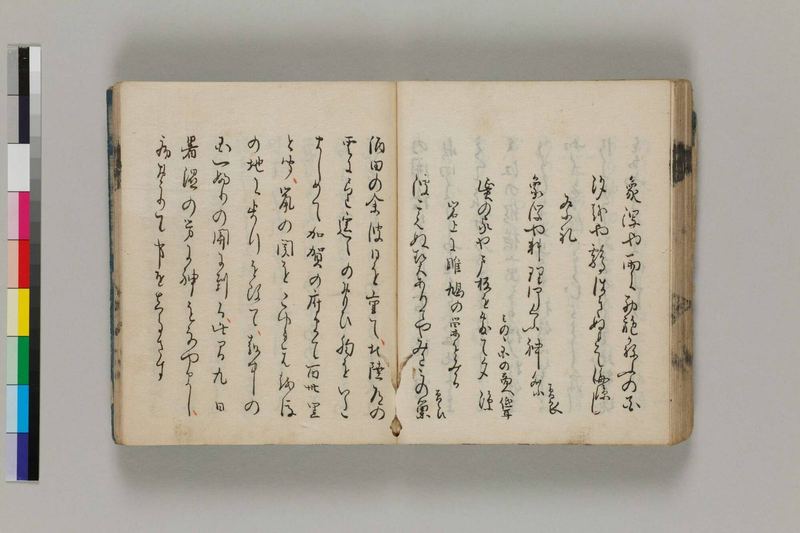
Oku no Hosomichi, 1702
Illustrated life
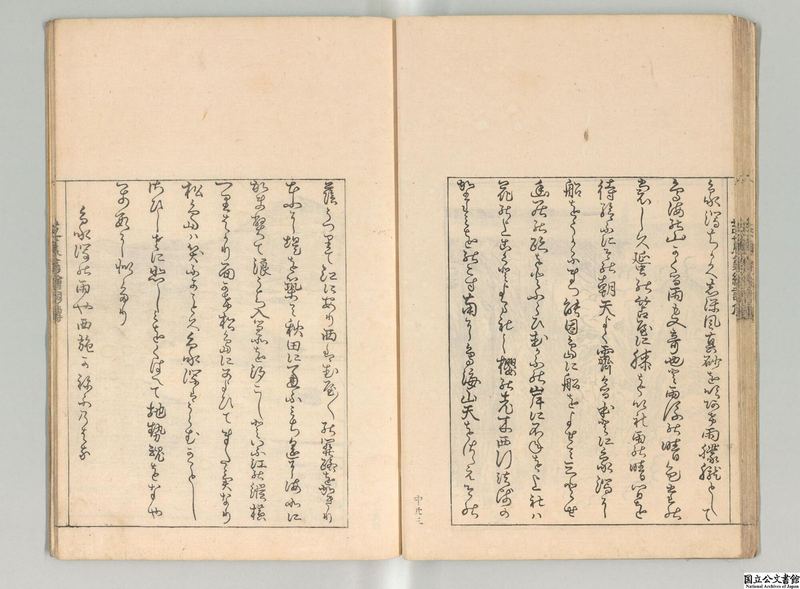
Illustrated life of Bashō, 1789–1801