Mount Haguro
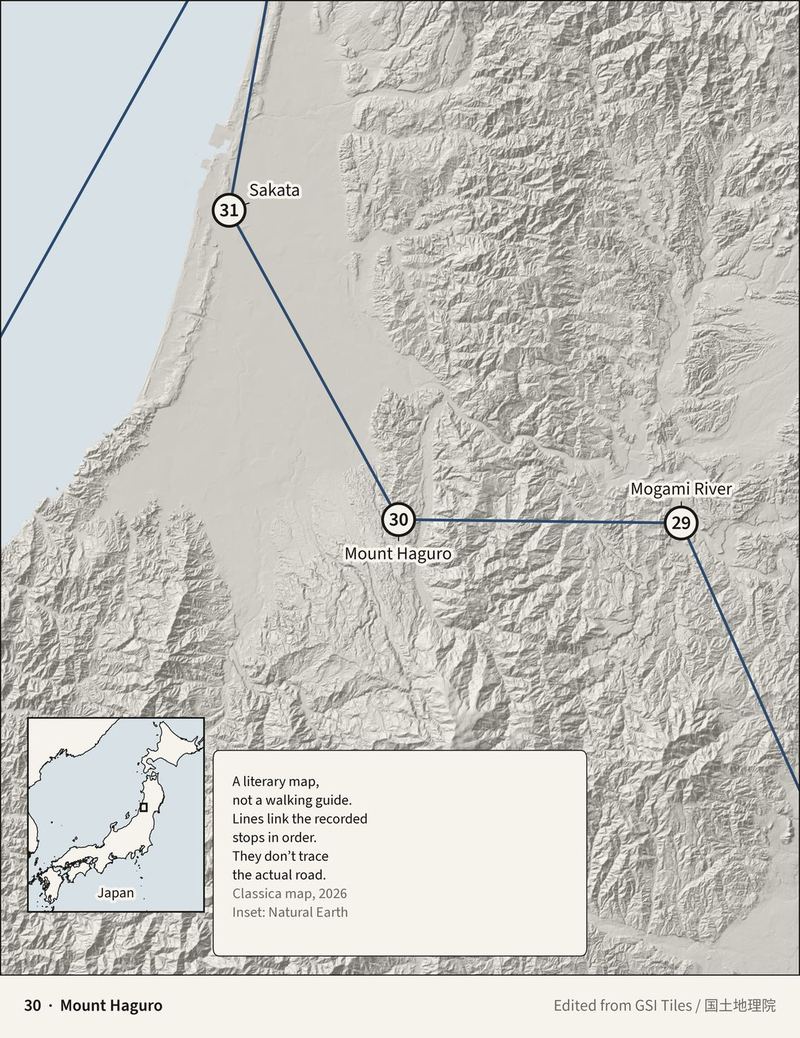
Map, Mount Haguro
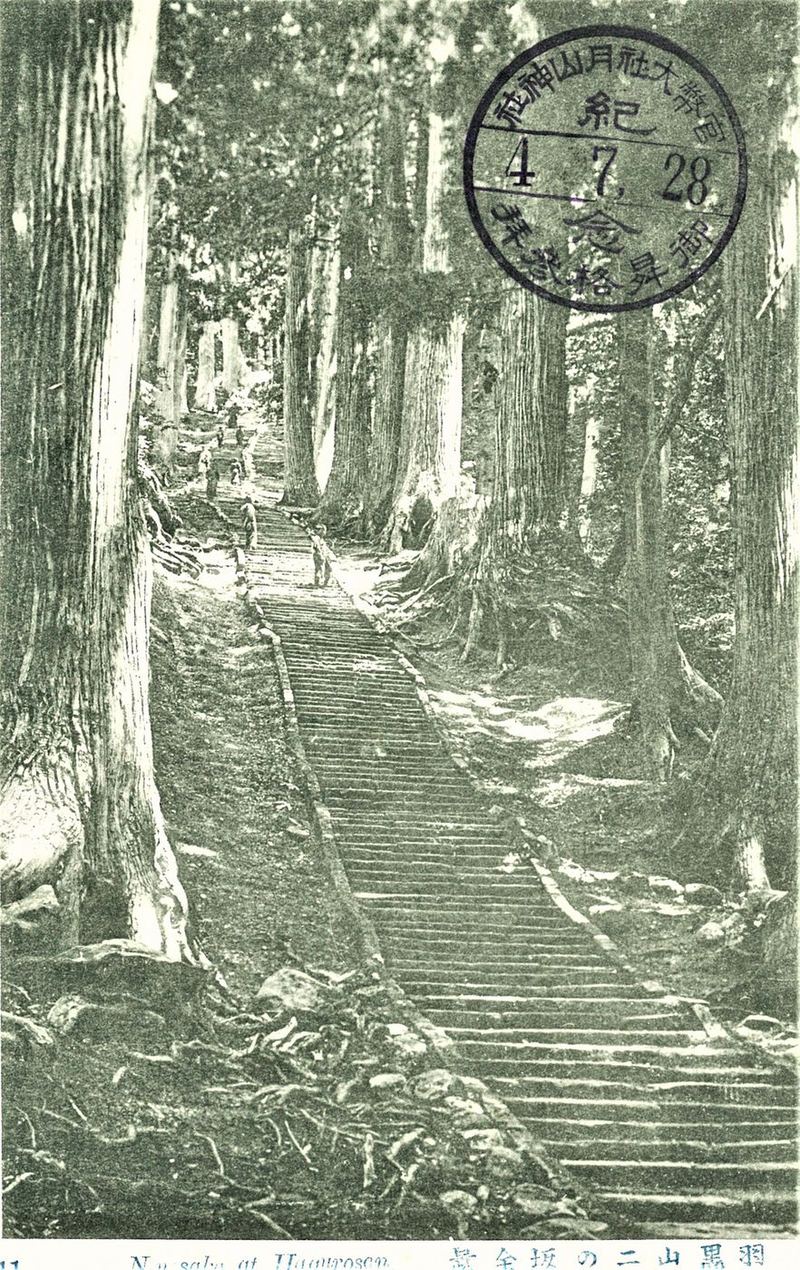
Mount Haguro stair, 1929
On the third day of the Sixth Month we climbed Mount Haguro. We called on a man named Zushi Sakichi, and through him were received by the Ajari Egaku, who serves in place of the abbot. He lodged us at the branch temple in Minamidani, the South Valley, and looked after us with tender kindness.
On the fourth, a haikai gathering was held at the main temple.
What a blessing—the South Valley lendsthe snow its fragrance
On the fifth we paid our respects at the shrine of the Gongen. No one knows in what age the Great Teacher Nōjo, who opened this mountain, lived. The Engi-shiki records a shrine of “Satoyama in Ushū.” Perhaps a copyist turned the character for “black” into “Sato.” Perhaps “Haguro” is simply “Ushū Kuroyama” with the middle cut out. As for the name Dewa, I am told the Fudoki says it comes from the feathers and down of birds that this province once sent as tribute. Together with Gassan and Yudono it makes up the Three Mountains. The temple belongs to Tōeizan in Edo. Here the moon of the Tendai teaching of stillness and insight shines clear, and the lamp of the doctrine of perfect, sudden interpenetration is held high beside it. The monks’ lodgings stand roof to roof, the mountain ascetics are diligent in their practice, and people revere and fear the wonders of this holy mountain and holy ground. Its prosperity will last forever; truly it is a sacred mountain worthy of praise.
On the eighth we climbed Mount Gassan. With a sacred cord of white cotton hung about us and our heads wrapped in a white hood, we were led by a man of the kind they call a mountain porter. Through cloud and mist and mountain vapor we trod on ice and snow and climbed eight leagues, until I half wondered whether we were passing through the cloud barrier on the road of the sun and moon. Out of breath and numb with cold, we reached the top just as the sun went down and the moon came out. We spread bamboo grass to lie on, made pillows of slender bamboo, and lay waiting for the dawn. When the sun was up and the clouds had cleared, we went down toward Yudono.
Beside the valley stands a place called the Smiths’ Hut. The smiths of this province chose this holy water, purified themselves here, and forged swords, carving on them at last the name “Gassan,” and the world prized them. They say swords were once tempered at the Dragon Spring in China; it called up the old days of Gan Jiang and Mo Ye. One could see how deep was their devotion to mastering their art. As I sat on a rock and rested a while, I saw a cherry tree no more than three feet tall with its buds half open. Buried under the drifted snow, the late cherry had not forgotten spring, and the heart of its blossoms moved me past reason. It was as though the Zen saying of “plum blossoms in the blazing heat” were giving off its fragrance here. Archbishop Gyōson’s poem and its sadness came back to me, and I felt it all the more. As a rule, the details of what is in these mountains may not be told to others; that is the law of the ascetics. So I stay my brush and write nothing more. When we returned to our lodging, at the Ajari’s request I wrote verses on our pilgrimage to the Three Mountains on slips of paper.
The cool of it—the faint new crescentover Haguro
How many peaksof cloud have crumbled away—the Mountain of the Moon
Yudono, not to be told—and still I wetmy sleeves
Yudono—on the path we walk on coins,and walk in tears— Sora
Traveler’s notes
On the third of the Sixth Month they climb Mount Haguro, call on Zushi Sakichi (圖司左吉), and are received by the Ajari Egaku (會覺阿闍利), who serves in place of the abbot. They lodge at Minamidani, the South Valley (南谷).
On the fourth a haikai gathering is held at the main temple. 有難や / 雪をかほらす / 南谷: 有難 is read arigata; かほらす is kaorasu, “makes fragrant.” Lingering snow in the Sixth Month scents the South Valley.
The Gongen shrine: no one knows in what age the Great Teacher Nōjo (能除大師) opened the mountain. The Engi-shiki has a shrine of “Satoyama in Ushū”; perhaps 黒 was copied as 里, and Haguro shortened from 羽州黒山. Dewa, the Fudoki is said to say, comes from bird feathers sent as tribute. With Gassan and Yudono it makes the Three Mountains. The temple belongs to Tōeizan in Edo; Tendai stillness-and-insight (止觀) and the lamp of perfect, sudden interpenetration (圓頓融通) are praised here.
On the eighth they climb Mount Gassan, eight leagues, with a white cotton cord and hood, led by a mountain porter (強力). At the Smiths’ Hut (鍛冶小屋), local smiths purified themselves in the holy water and forged swords inscribed Gassan — like tempering at China’s Dragon Spring (龍泉), and like Gan Jiang and Mo Ye (干將・莫耶). A three-foot cherry, half open under snow, has not forgotten spring; it is like the Zen phrase of plum blossoms in blazing heat (炎天の梅花). Archbishop Gyōson’s poem and its sadness come back to him. The ascetics’ rule forbids telling the mountain’s details, so he stays his brush.
凉しさや / ほの三か月の / 羽黒山: coolness (a summer kigo) and a faint crescent (三か月, mikazuki) over Haguro. 雲の峰幾つ崩て月の山: summer thunderheads (雲の峰) crumble away; 月の山 is Gassan, the Mountain of the Moon. 語られぬ湯殿にぬらす袂かな: what is in Yudono may not be told; ぬらす袂 is sleeves made wet — by tears, and perhaps also by the sacred water.
Sora: 湯殿山錢ふむ道の泪かな. Pilgrims throw coins on the path at Yudono and walk on them (錢ふむ).
Riichi’s 1778 notes
On the third day of the Sixth Month we climbed Mount Haguro. We called on a man named Zushi Sakichi, and through him were received by the Ajari Egaku, who serves in place of the abbot. He lodged us at the branch temple in Minamidani, the South Valley, and looked after us with tender kindness.
阿闍黎, according to the Essential Reader for the Śākya Clan (釋氏要覽, Shishi yaolan), citing the Record of the Return (寄歸傳): “Ācārya (阿遮黎那) means, in the Tang speech, a model and a rule” (唐言軌範). … 阿闍黎 is the name for a master from whom the esoteric teaching is received, he says. It is limited to the two schools of Tendai and Shingon. … it means to meet someone face to face. Minamidani (南谷) is the name of a valley on Mount Haguro; there are a North Valley, a Middle Valley and a South Valley. Both characters of 憐愍 are read aware, “pity”; the Nirvana Sutra (涅槃經) has “compassion for all sentient beings” (憐愍一切衆生).
What a blessing—
the South Valley lends
the snow its fragrance
The conception of this verse 〓 “A fragrant wind comes of itself from the south” (薫風自南来) 〓. …
On the fifth we paid our respects at the shrine of the Gongen. No one knows in what age the Great Teacher Nōjo, who opened this mountain, lived. The Engi-shiki records a shrine of “Satoyama in Ushū.” Perhaps a copyist turned the character for “black” into “Sato.” Perhaps “Haguro” is simply “Ushū Kuroyama” with the middle cut out.
The enshrined deity of Mount Haguro is Ukanomitama no Mikoto (倉稲魂命); the god appeared in this province in the first year of Empress Suiko. … The Great Teacher Nōjo opened the mountain as a whole. … The Fudoki (風土記) 〓 even now this province sends out many eagle feathers. Together with Gassan and Yudono it makes up the Three Mountains. Gassan is the peak of Mount Haguro and Mount Yudono. Yudono is the inner sanctuary of the two mountains, and its founding is the same as Haguro’s. Mount Yudono is a sacred ground of Dainichi, and was opened, they say, by En no Gyōja (役行者). … Therefore these mountains are said to be the Three Mountains in one body. The temple belongs to Tōeizan in Edo (武江東叡). Here the moon of the Tendai teaching of stillness and insight shines clear, and the lamp of the doctrine of perfect, sudden interpenetration is held high beside it; the monks’ lodgings stand roof to roof, the mountain ascetics are diligent in their practice, and people revere and fear the wonders of this holy mountain and holy ground. Stillness and insight (止觀) is a matter of contemplative practice, and belongs to the Tendai house 〓. … “Interpenetration” (融通) 〓 means passing from this to that and from that to this. … A verse says, “A single point of lamplight is handed on and on” (一點燈光續續傳). Zen books too have the name Record of the Transmission of the Lamp (傳燈録). “Sacred mountain” (靈山) means Vulture Peak (靈鷲山) in India, the place where the World-Honored One preached the Dharma. 驗效 is in every case read shirushi, “a sign”; common speech says it of there being gen, a visible wonder.
On the eighth we climbed Mount Gassan. With a sacred cord of white cotton hung about us and our heads wrapped in a white hood, we were led by a man of the kind they call a mountain porter. Through cloud and mist and mountain vapor we trod on ice and snow and climbed eight leagues. …
Beside the valley stands a place called the Smiths’ Hut. The smiths’ hut: those who practice the trade are now gone, and only the name remains; it has become a lodging for pilgrims. To quench a blade (淬): the Geographical Record of the Taikang Era of Jin (晉太康地理記) says, “Southwest of the water, in Xiping district, there is the Dragon Abyss Spring” (水南西平縣有龍淵水) 〓. … The Spring and Autumn of Wu and Yue (呉越春秋, Wu Yue chunqiu) says that Gan Jiang was a man of Wu, and shared a teacher with Ou Yezi. … The Extensive Records of the Taiping Era (太平廣記, Taiping guangji) says, “The swords of Gan Jiang and Mo Ye were all cast of copper, not of iron.” It is a devoted heart. … “Plum blossoms in the blazing heat” 〓. Archbishop Gyōson 〓 the Genkō History of Buddhism 〓. …
As a rule, the details of what is in these mountains may not be told to others; that is the law of the ascetics. So I stay my brush and write nothing more.
微, according to the Yupian (玉篇), means “fine, and not clear” (細也、不明也). 法式 means the ordinances and codes (法度式目).
Yudono, not to be told—
and still I wet
my sleeves
In these mountains 〓 it may not be told 〓. …
Yudono—
on the path we walk on coins,
and walk in tears
— Sora
…
1702 first printing
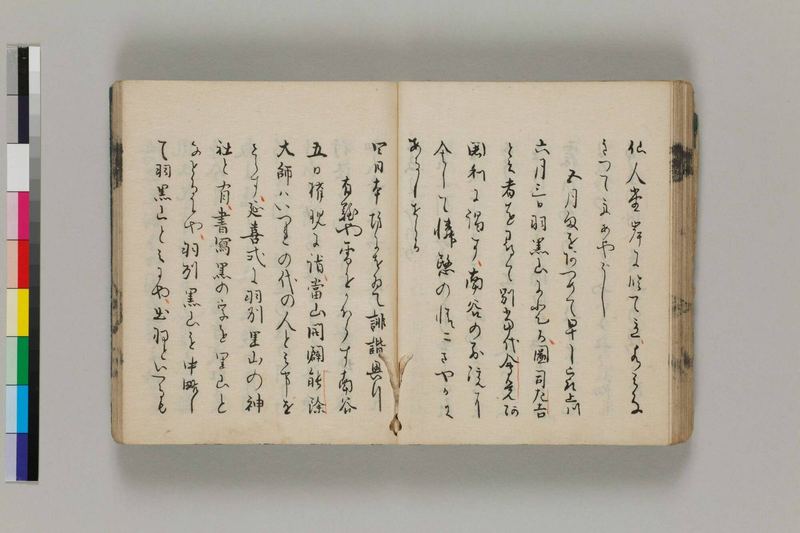
Oku no Hosomichi, 1702