Ryūshakuji Temple
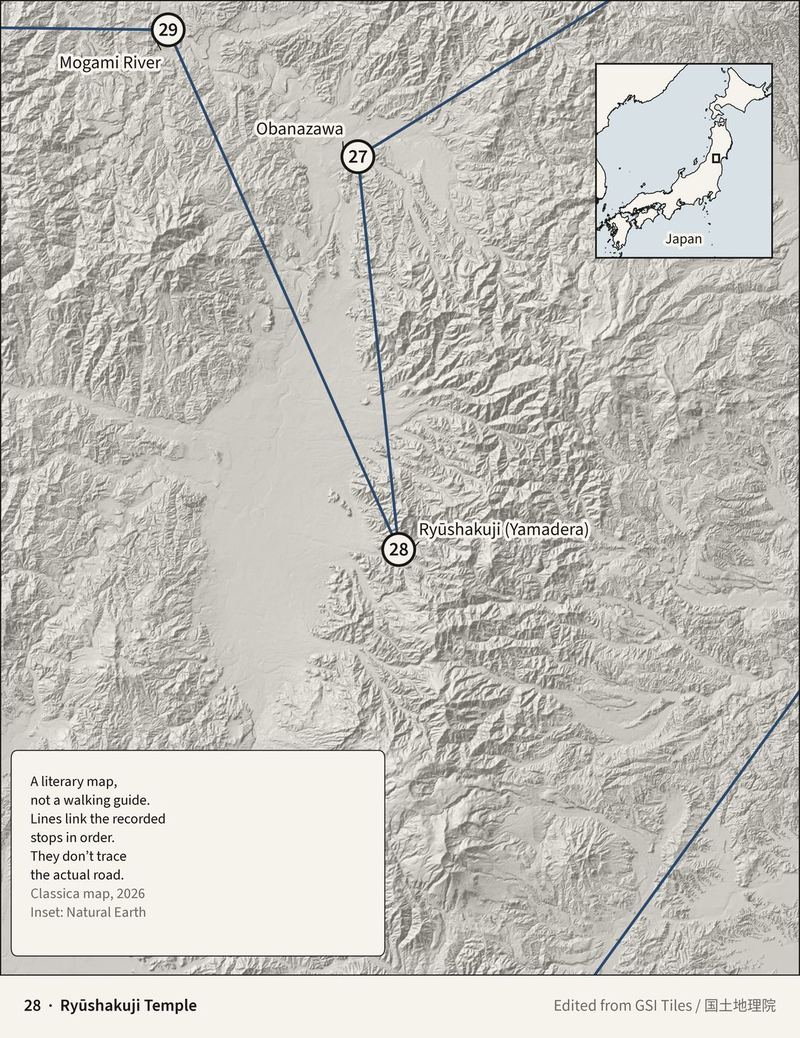
Map, Ryūshakuji Temple
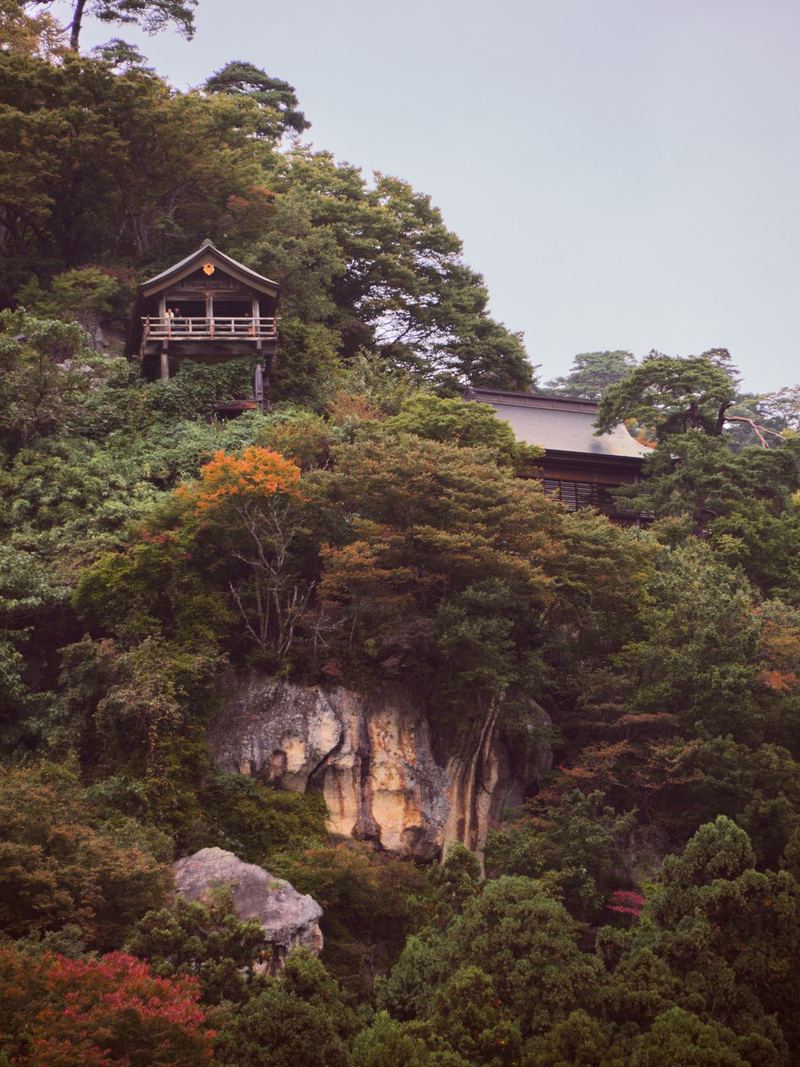
Yamadera
By the way
They’d already reached Obanazawa. People said this temple shouldn’t be missed, so they turned back some seven leagues. Now that’s a recommendation.
In the domain of Yamagata there is a mountain temple called Ryūshakuji. It was founded by the Great Teacher Jikaku and is a place of rare purity and calm. People urged us to see it, so we turned back from Obanazawa, a distance of some seven leagues. The sun had not yet set. We arranged lodging at a temple lodge at the foot of the mountain and climbed up to the halls on the summit. Rock is piled on rock to make the mountain; the pines and cypresses are full of years, the earth and stones are old and slippery with moss, and the doors of the little temples on the crags were shut, with not a sound to be heard. We went around the cliffs and crawled over the rocks to pay our respects at the Buddha halls, and in that lovely, lonely scene I felt only my heart growing clear.
Quiet all round—the voice of the cicadassoaking into the rock
Traveler’s notes
Ryūshakuji, in the domain of Yamagata, was founded by the Great Teacher Jikaku (慈覺大師, Ennin). People urge them to see it, so they turn back from Obanazawa, some seven leagues.
They take lodging at a temple lodge at the foot and climb to the halls on the summit: rock piled on rock, old pines and cypresses, moss-slick earth and stone, the doors of the cliff temples shut, no sound.
閑さや / 岩にしみ入 / 蝉の聲: 閑さ is read shizukasa (not kan); や is the cutting word; しみ入 is shimiiru, “soak into.” The cicada (蝉, a summer kigo) is heard so deeply that its voice seems to enter the rock, and the stillness grows clearer.
Riichi’s 1778 notes
In the domain of Yamagata there is a mountain temple called Ryūshakuji. It was founded by the Great Teacher Jikaku and is a place of rare purity and calm.
It is now called Yamadera (山寺). … It resembles Mount Akagi in the province of Musashi. The Genkō History of Buddhism (元亨釋書, Genkō Shakusho) says: The monk Ennin (圓仁), of the Mibu clan, was a man of Tsuga district in the province written 野之下州. He was born in the thirteenth year of Enryaku. At the age of nine he served the monk Hirochi (廣智) of Daijikakuji (大慈覺寺) in the same district. At fifteen he took Dengyō (傳教) as his teacher. At twenty-three he received the complete precepts at Tōdaiji in Washū. In the fifth year of Jōwa he entered Tang in the train of the ambassador Fujiwara no Tsunetsugu. In the fourteenth year he returned to the court. In the fourth month of the fourth year of Ninju he was appointed abbot of Mount Hiei. He died on the fourteenth day of the first month of the sixth year of Jōgan, at the age of seventy-two. In the eighth year he was granted the posthumous title Great Teacher Jikaku.
○ The villagers of Yamadera pass down that there was a bad line (惡理; in common speech, a sinew or vein, 筋) in the Great Teacher Jikaku’s hand. People say that one who has such a pulse-line is sure to meet with the misfortune of a blade-wound. For this reason, greatly …
We went around the cliffs and crawled over the rocks to pay our respects at the Buddha halls, and in that lovely, lonely scene I felt only my heart growing clear.
閣, according to the Zhengzitong (正字通), means a tower or viewing-hall (樓觀也). It should be the name by which one praises the soaring look of a Buddha hall. Both characters of 寂寞, he says, are read sabishi, “lonely.” The Expedient Means chapter of the Lotus Sutra (法華經方便品) has the phrase “lonely and still, without a sound” (寂寞無聲). It is what common speech calls shizuka, “quiet”: one says it of things that are still.
Quiet all round—
the voice of the cicadas
soaking into the rock
1702 first printing
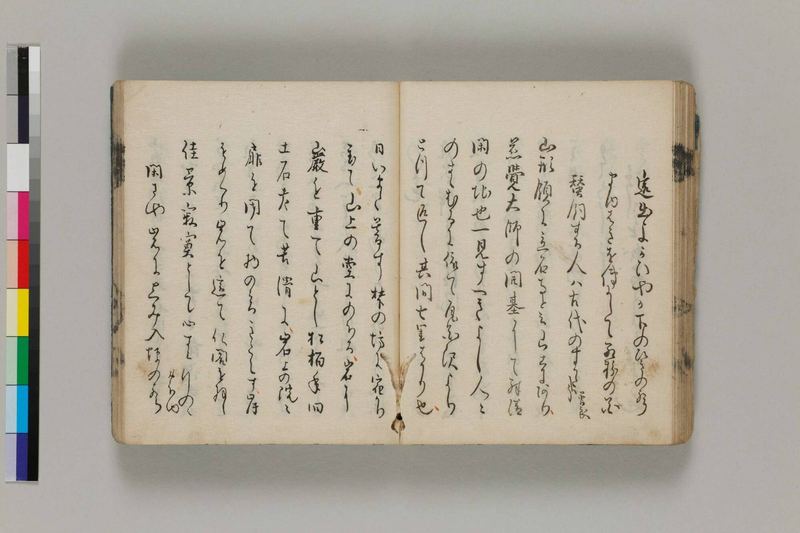
Oku no Hosomichi, 1702