Yamanaka Hot Springs
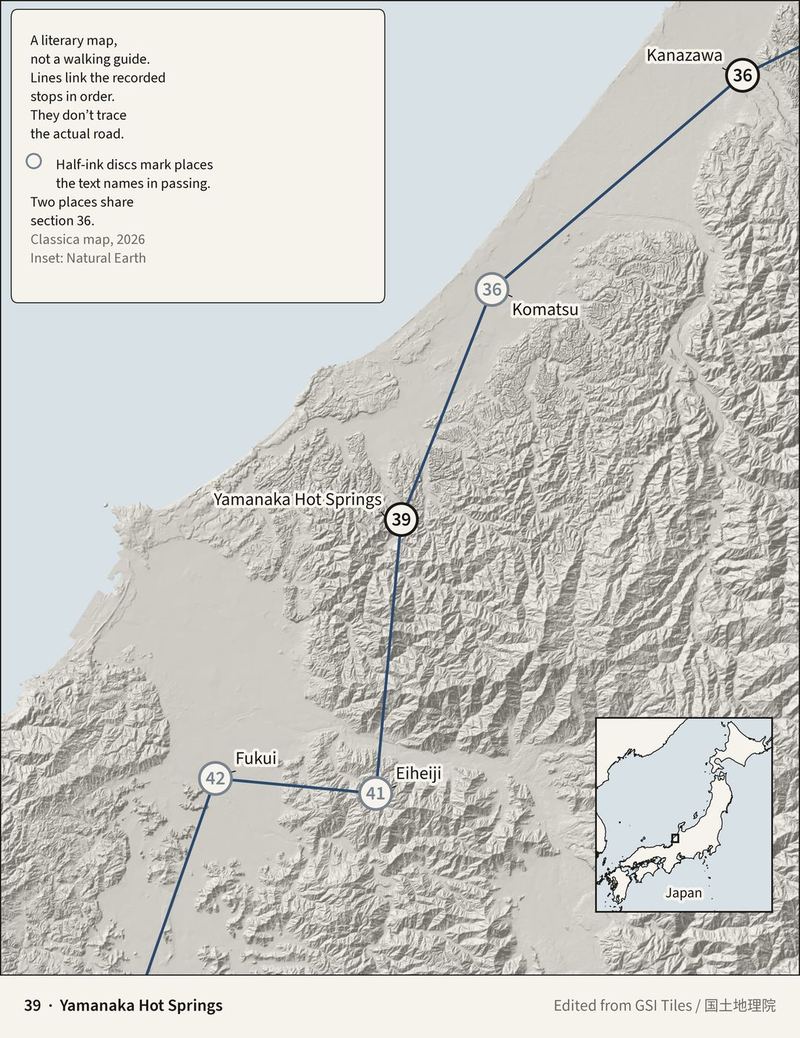
Map, Yamanaka Hot Springs
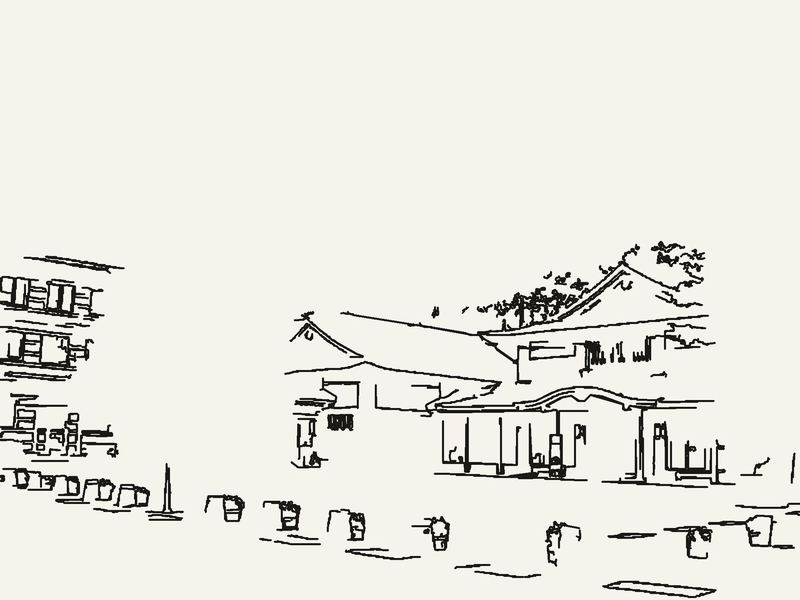
Yamanaka
By the way
Sora goes on ahead from here, unwell, to relatives in Ise. No spoilers, but keep an eye on Ōgaki.
We bathed in the hot springs. Their virtue, they say, is second only to Ariake.
Yamanaka—no need to pick chrysanthemumswith this scent from the springs
Our host was a boy named Kumenosuke, still a child. His father was fond of haikai. When Teishitsu of the capital came here long ago, in his youth, he was put to shame in matters of poetry, went back to the capital, became a disciple of Teitoku, and made a name in the world. After he grew famous, they say, he would accept no fee from anyone in this village for judging their verses. All that has now become a tale of the old days.
Sora had trouble with his stomach, and because he had relatives at a place called Nagashima in the province of Ise, he went on ahead, leaving these lines behind:
On and on I go,and if I fall and lie there—a field of bush clover— Sora
The sorrow of the one who goes and the regret of the one left behind: it was like a lone wild duck parted from its mate, lost among the clouds. I, too, wrote:
From this day onI’ll wash away with dewwhat is written on my hat
Traveler’s notes
They bathe in the hot springs, whose virtue is said to be second only to Ariake (有明).
山中や / 菊はたおらぬ / 湯の匂: no need even to pick chrysanthemums (whose dew was thought to lengthen life) when the water itself has this scent. Chrysanthemum is an autumn kigo. たおらぬ is ta oranu.
The host is a boy, Kumenosuke (久米之助). His father loved haikai. Teishitsu (貞室) of the capital, shamed here in his youth, went home, became a disciple of Teitoku (貞徳), and later would take no fee from this village for judging verses.
Sora is ill and goes ahead to relatives at Nagashima in Ise. 行〳〵て / たふれ伏とも / 萩の原: 行〳〵て is yukiyukite, “going on and on”; even if he falls and lies there, a field of bush clover.
The sorrow of the one who goes and the regret of the one left behind is like 隻鳧, one duck of a pair parted from its mate, lost among the clouds. 今日よりや / 書付消さん / 笠の露: from this day he will let the dew erase what is written on his hat (a traveling companion’s name). 今日 is kyō.
Riichi’s 1778 notes
We bathed in the hot springs. Their virtue, they say, is second only to Ariake.
浴 is read yu-amu. … Arima 〓. People of the world too 〓.
Yamanaka—
no need to pick chrysanthemums
with this scent from the springs
The Erya (爾雅) says, “The chrysanthemum has 〓 a fragrant vapor and a fine taste; if one can take it, it may put an end to illness and extend the years.” The Miscellaneous Records of the Western Capital (西京雜記, Xijing zaji) says, “On the ninth day of the Ninth Month one wears cornel, eats a prepared meal and drinks chrysanthemum wine, and this makes people long-lived.” A treatise 〓 says, “The cornel is called the old man who wards off evil; the chrysanthemum is called the guest who extends life.” The Biographies of Arrayed Immortals (列仙傳, Liexian zhuan) says, “Pengzu took chrysanthemums and lived long, to the age of more than seven hundred years.” …
Our host was a boy named Kumenosuke, still a child.
Tōyō (桃妖), it is said, 〓. When Teishitsu of the capital came here long ago, in his youth, he was put to shame in matters of poetry, went back to the capital, became a disciple of Teitoku, and made a name in the world. After he grew famous, they say, he would accept no fee from anyone in this village for judging their verses. …
Sora had trouble with his stomach, and because he had relatives at a place called Nagashima in the province of Ise, he went on ahead, leaving these lines behind:
On and on I go,
and if I fall and lie there—
a field of bush clover
— Sora
The sorrow of the one who goes and the regret of the one left behind: it was like a lone wild duck parted from its mate, lost among the clouds.
A verse says, “Both wild ducks flew north together” (雙鳧俱北飛) 〓. 隻 is read shoku; 〓 the Zhengzitong (正字通) says, “When a thing is not a pair, it is called 隻”; in common speech one says kataku, and it differs in both sound and sense from 雙.
1702 first printing
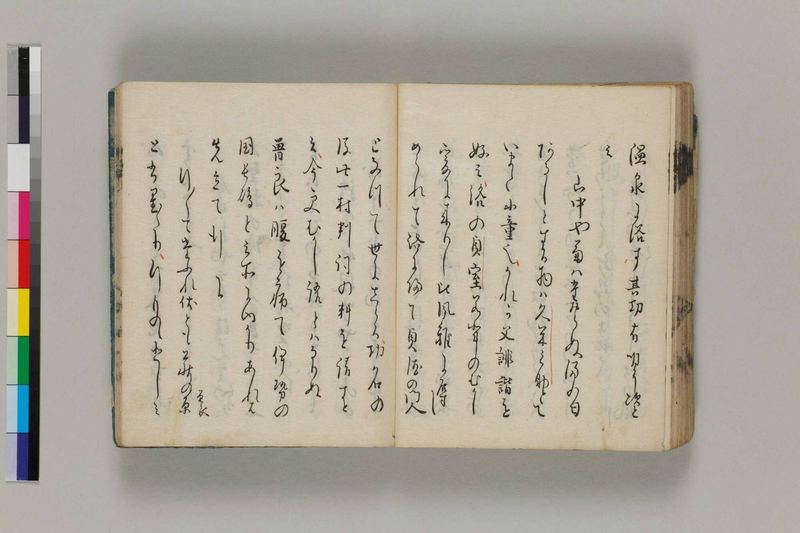
Oku no Hosomichi, 1702