The Old Seat of Satō the Steward
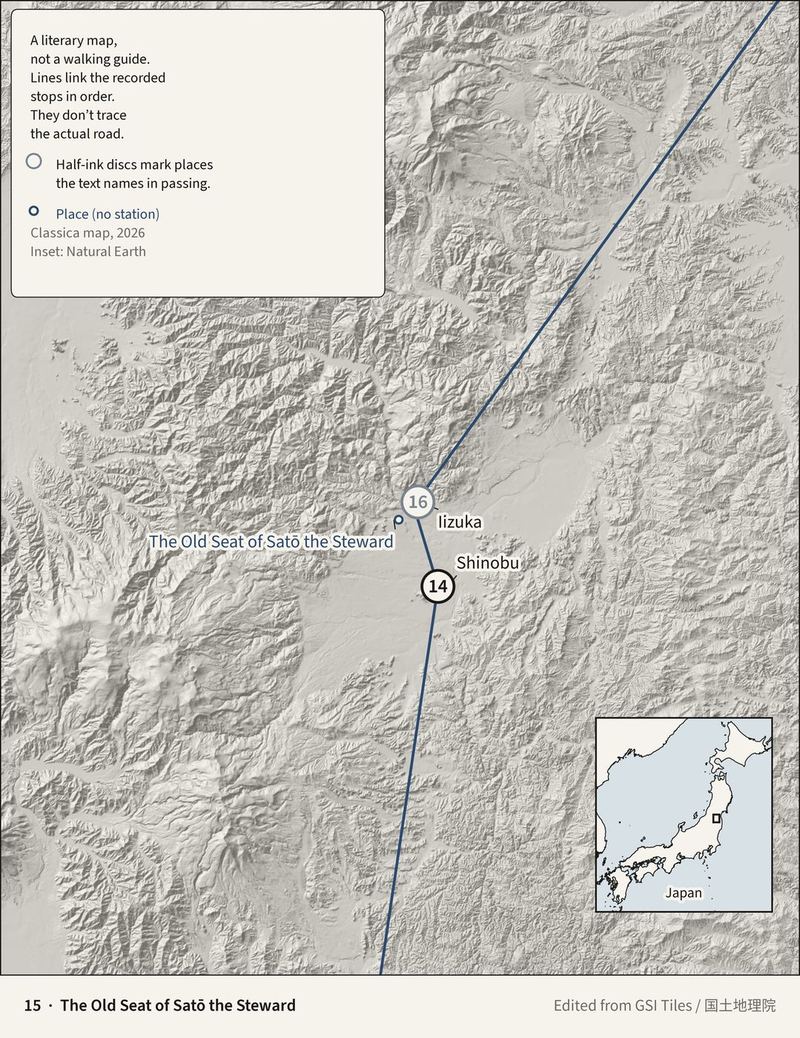
Map, The Old Seat of Satō the Steward
We crossed by the Tsukinowa ferry and came out at a post town called Senoue. The old seat of Satō the Steward lies a league and a half off to the left, at the foot of the hills. We were told it was at Sabano in the village of Iizuka, and asking our way again and again as we went, we came at last to a place called Maruyama. This was the Steward’s old residence. When people showed us the remains of the main gate at the foot of the hill, and other such things, I let my tears fall. In an old temple nearby, the gravestones of the family still remain. Of them all, the stones of the two young wives moved me first and most. Women though they were, they had left a name in the world for steadfast courage, and I wet my sleeves. There was no need to travel far to find a stone of falling tears.
We went into the temple and asked for tea. Here they keep Yoshitsune’s sword and Benkei’s pack-basket among the temple treasures.
The pack-basket, the sword—set them out for the Fifth Monthwith the paper banners
It was the first day of the Fifth Month.
Traveler’s notes
They cross by the Tsukinowa ferry (月の輪のわたし) to Senoue (瀬の上). The old seat of Satō the Steward (佐藤庄司) lies at Maruyama, said to be at Sabano in the village of Iizuka.
Satō Motoharu’s two sons, Tsugunobu and Tadanobu, died serving Yoshitsune. The stones of the two young wives (二人の嫁) moved Bashō most; though women, they left a name for steadfast courage (かひ〴〵しき = kaigaishiki).
墜涙の石碑, “a stone of falling tears,” alludes to the stele of Yang Hu in Xiangyang, so moving that passers-by wept. Bashō says he did not need to travel far to find one.
In the temple they keep Yoshitsune’s sword (太刀) and Benkei’s pack-basket (笈) as treasures. It was the first day of the Fifth Month.
笈も太刀も / 五月にかざれ / 紙幟: display the basket and sword for the Fifth Month with the paper banners (紙幟) of the Tango festival, as warrior relics are set out then. The first phrase is jiamari (six morae: oi mo tachi mo).
1702 first printing
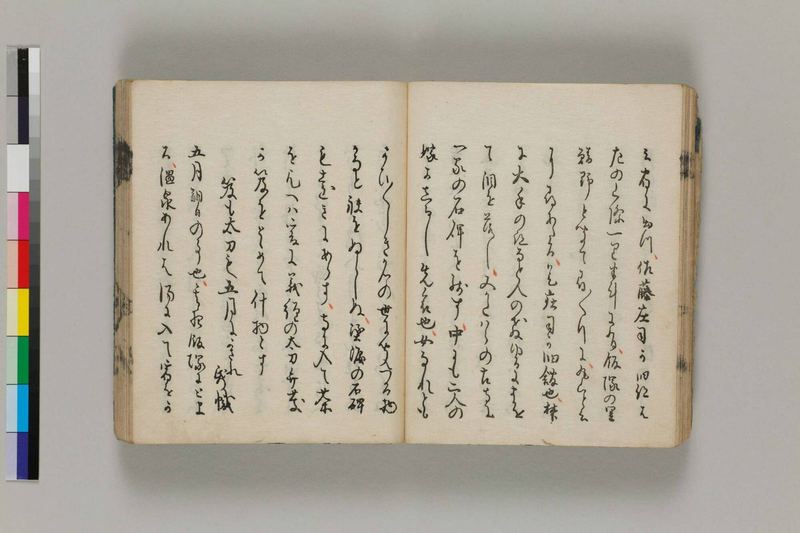
Oku no Hosomichi, 1702