Ichiburi
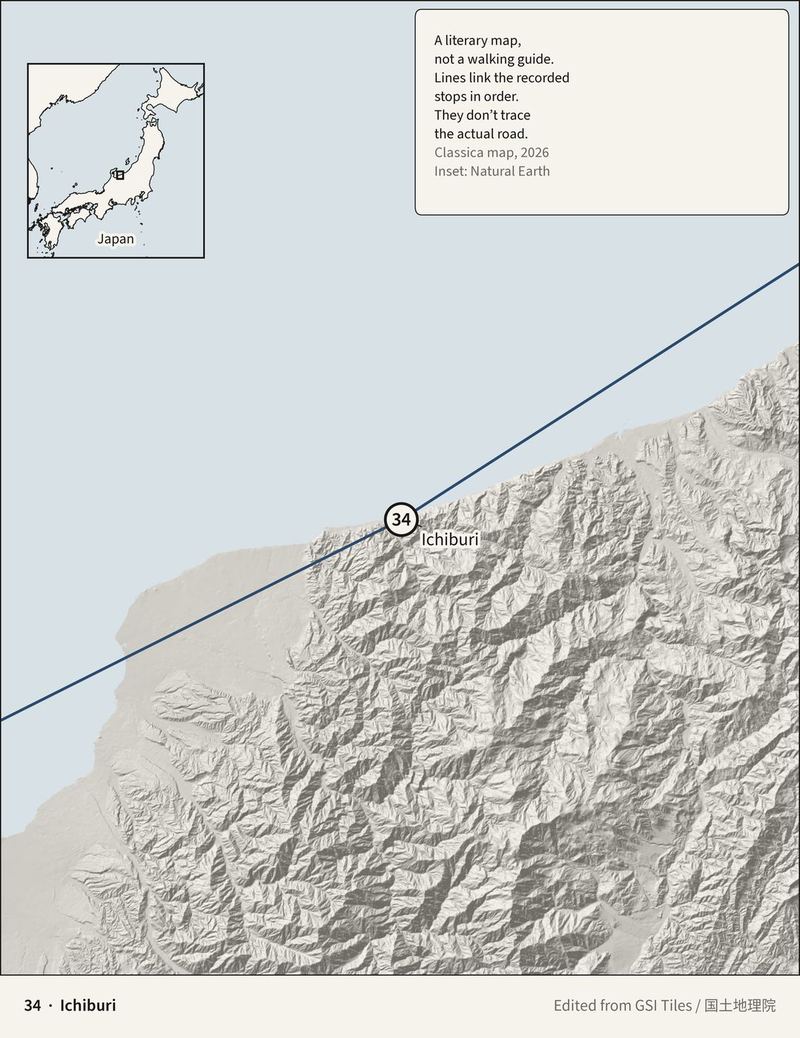
Map, Ichiburi
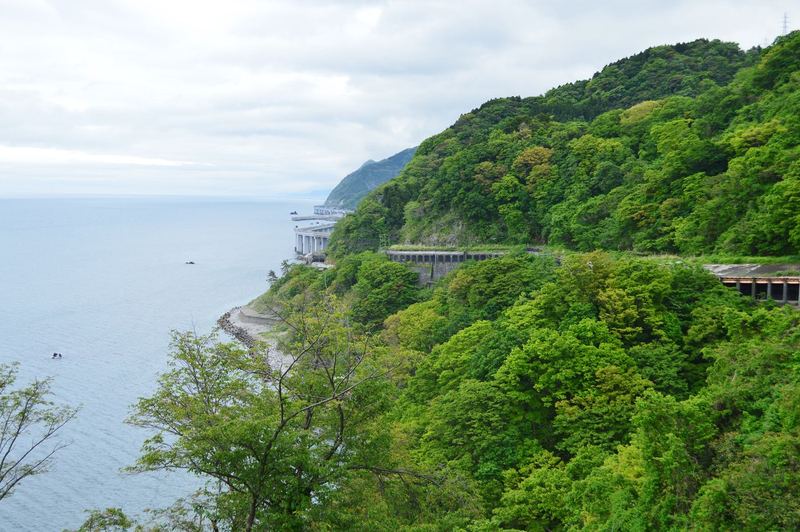
Oyashirazu coast
Today we had crossed the hardest places in all the northern provinces, with names like Oyashirazu and Koshirazu, “Parent Forgets Child, Child Forgets Parent,” Inumodori, “Where the Dog Turns Back,” and Komagaeshi, “Where the Horse Is Sent Home.” I was worn out, and pulled my pillow close and lay down to sleep, when from the front room, one room away, I heard the voices of young women, two of them, it seemed. An old man’s voice was mixed in with theirs, and as I listened to them talk I learned that they were women of pleasure from a place called Niigata in the province of Echigo. They were going on pilgrimage to the Grand Shrine of Ise, and the man had seen them as far as this barrier; tomorrow they would send him home, and they were writing letters for him to take and giving him their little messages. “Cast away on the shore where the white waves break, sunk so low in this world, like the fishermen’s daughters, making our faithless vows to a new man each night—what wretched karma we must have,” I heard them say, and as I listened I fell asleep. In the morning, as we were setting out, they turned to us. “We do not know the way, and the hardship of the road frightens us and makes us so sad. Let us follow after you, even if only at a distance, keeping you just in sight. In the kindness of your robes, grant us the mercy of the Buddha’s great compassion, and let us be joined to it,” they said, and wept. “I am sorry for you,” I said, “but we will be stopping in many places along the way. Just go along with the other travelers you meet. The gods will surely see you safely through.” With that I left them, but for a long time I could not stop feeling for them.
In the same housewomen of pleasure sleeping too—bush clover and the moon
I told this to Sora, and he wrote it down.
Traveler’s notes
They have crossed the hardest places in the northern provinces: Oyashirazu and Koshirazu (“Parent Forgets Child, Child Forgets Parent”), Inumodori (“Where the Dog Turns Back”), and Komagaeshi (“Where the Horse Is Sent Home”).
In the next room, women of pleasure (遊女) from Niigata in Echigo are going on pilgrimage to Ise. A man has seen them as far as this barrier; tomorrow they will send him home with letters and little messages.
They speak of being cast on the shore where the white waves break, sunk like the fishermen’s daughters, making faithless vows night after night — wretched karma. In the morning they ask to follow Bashō, even at a distance, and to be joined to the mercy of his robes. He tells them to go with other travelers; the gods will see them through. For a long time he cannot stop feeling for them.
一家に / 遊女もねたり / 萩と月: in the same house, women of pleasure sleeping too — bush clover and the moon (both autumn). He told the verse to Sora, who wrote it down.
Riichi’s 1778 notes
Today we had crossed the hardest places in all the northern provinces, with names like Oyashirazu and Koshirazu, “Parent Forgets Child, Child Forgets Parent,” Inumodori, “Where the Dog Turns Back,” and Komagaeshi, “Where the Horse Is Sent Home.”
Along this seacoast 〓 there are steep mountains, and below them the sea 〓. … even parent and child 〓. … Inumodori 〓. Komagaeshi 〓.
They were women of pleasure from a place called Niigata in the province of Echigo.
Women of pleasure (遊女), in China, are called ji, “singing-girls.” … In antiquity, they say, there were not yet such ji; Emperor Wu of Han first established official singing-girls to attend soldiers who had no wives. The name 遊女 may come from the phrase in the Songs, “There is a wandering girl on the Han” (漢有遊女). But the sense of that poem is only a girl walking along the Han River. … In Japan the singing-girls of Murotsu in Banshū are taken as the beginning. … The Assembled Records of Court and Country (朝野群載, Chōya gunsai) says, “At Eguchi, Kannon is held as the founder; at Kanijima, Miyagi is held as the ancestor; at Kanzaki, Princess Kawo-ogi is held as the elder.” … The Later Gleanings of Japanese Poems (後拾遺和歌集, Goshūi wakashū) records a poem by the singing-girl Miyagi. The Tale of Genji 〓 records that when the Shining Genji went to worship at Sumiyoshi, Tamakazura’s procession set the singing-girls’ boats of Eguchi and Kanzaki afloat for him to see. That being so, there were already singing-girls by the time of Emperor Go-Ichijō, it would seem. The Man’yōshū (萬葉集) also has the phrase “wandering women” (遊行婦女), which sounds of a kind with singing-girls; so they may already have existed in the reign of Empress Kōken. … The Former Taiheiki (前太平記) 〓. According to another account, in the reign of Emperor Toba the lay monk Michinori (通憲入道) had his concubine Gizen-shi (儀禪師) put on an eboshi cap and a suikan robe, gird on a sword and dance, and this was called a man’s dance (男舞). That this was the beginning of the singing-girls’ dance is seen in the Record of the Rise and Fall of the Genji and the Heike (源平盛衰記, Genpei seisuiki). … The name “city-toppler” (傾城) comes from the History of the Former Han (前漢書), Biographies of the Imperial Affines (外戚傳): Li Yannian’s younger sister was surpassingly beautiful, … and he sang, “In the north there is a fair one, unique in the world, who stands alone; one glance topples a city, another glance topples a state; I would not grudge city or state, but a fair one is hard to find again” (北方有佳人、絶世而獨立、一顧傾人城、再顧傾人國、不惜城與國、佳人難再得). From this song a beautiful woman came to be called one who topples cities and states; in later ages it became a name for a singing-girl.
They were going on pilgrimage to the Grand Shrine of Ise 〓. The Inner Shrine is of Amaterasu Ōmikami, in Uji district; the Outer Shrine is of Toyouke Ōmikami, in Watarai district; both stand on the plain of Yamada. The enshrinement of each, they say, was in the winter, in the tenth month of the twenty-sixth year of Emperor Suinin.
Cast away on the shore where the white waves break, sunk so low in this world, like the fishermen’s daughters 〓. … karmic deeds (業因) 〓. It is what common speech calls low and base. … The Gleanings from Ancient Words (古語拾遺, Kogo shūi) reads it yatsukare 〓. 加護 is read 〓. The Forest of Gems in the Garden of the Dharma (法苑珠林, Fayuan zhulin) has “to obtain and accomplish this protective aid as an expedient” (得成此加護方便). The explanation of the sense is already given above.
1702 first printing
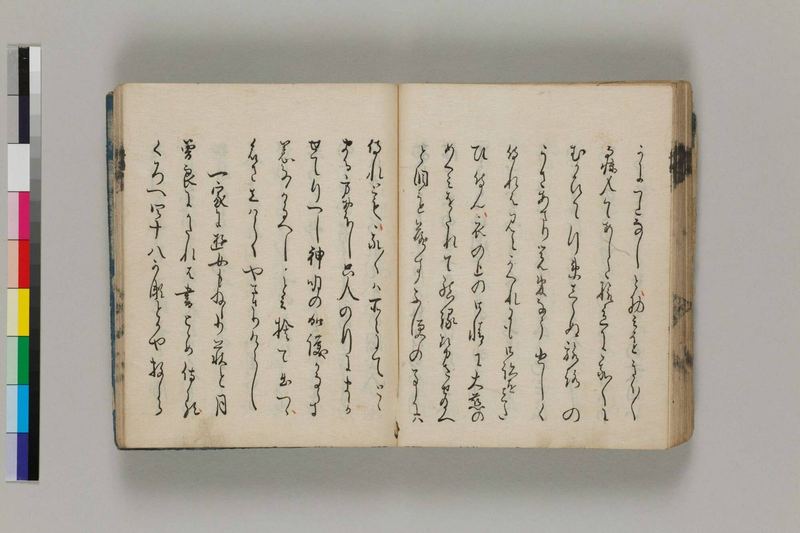
Oku no Hosomichi, 1702