Sue no Matsuyama
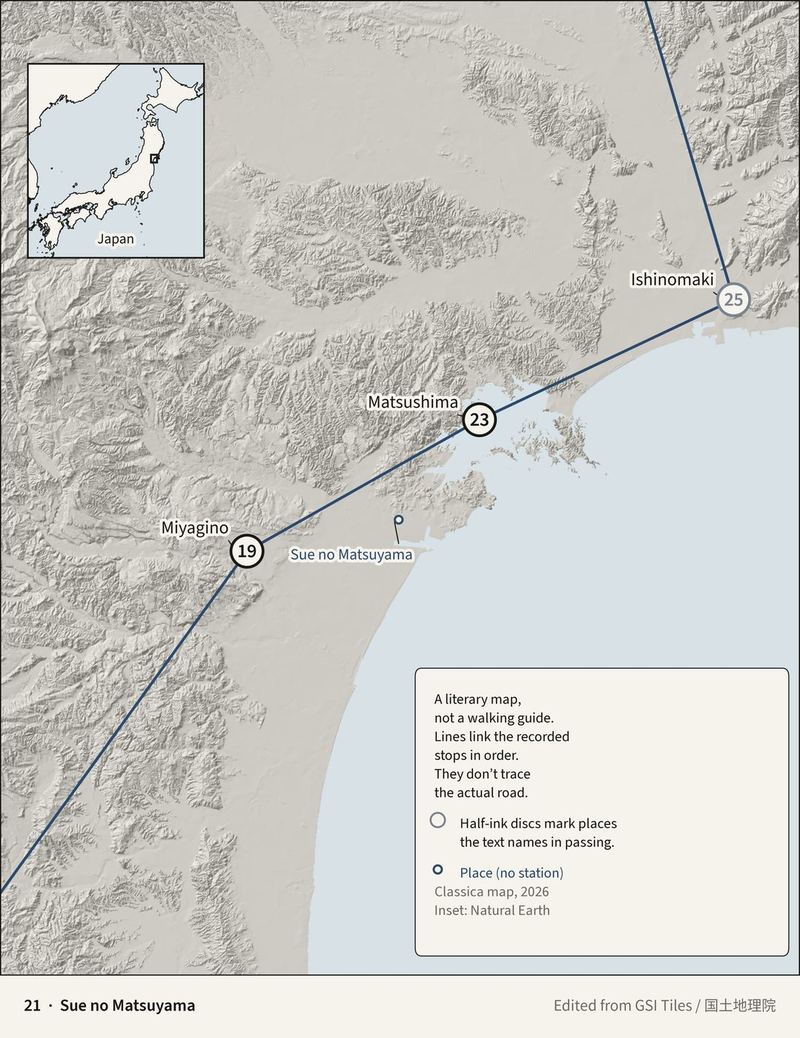
Map, Sue no Matsuyama
From there we sought out the Jewel River of Noda and the Rock in the Offing. At Sue no Matsuyama a temple has been built, and it is called Masshōzan. The spaces between the pines are all graveyard, and the vows of lovers to be birds sharing one pair of wings, or trees whose branches grow into one, must come in the end to this. With that thought my sadness deepened, and I heard the evening bell sounding over the bay at Shiogama. The Fifth-Month rains had let up a little, and in the faint light of the early moon Magaki Island seemed quite close. Fishermen came rowing in together in their little boats, and as I listened to their voices calling out the shares of the catch, I understood the feeling of the old poet who sang how moving it is to see the boats drawn by their towropes, and I was all the more stirred.
That night a blind monk played the biwa and chanted what they call Oku-jōruri, the ballads of the deep north. It was neither the tales of the Heike nor the dance-songs, but a rustic tune pitched high, and it was loud so close to my pillow; still, I found it admirable that the old ways of this remote country had not been forgotten.
Traveler’s notes
The Jewel River of Noda (野田の玉川) and the Rock in the Offing (沖の石) are nearby utamakura. Sue no Matsuyama has a temple called Masshōzan (末松山).
The pines stand among graves. Vows “to be birds sharing one pair of wings, or trees whose branches grow into one” (はねをかはし枝をつらぬる契) come from Bai Juyi’s Song of Everlasting Sorrow (比翼鳥、連理枝); even those vows end here.
Sue no Matsuyama is also the place lovers swear the waves will never wash over — so a graveyard among those pines cuts deeply. The evening bell sounds over Shiogama bay.
In the faint early moon Magaki Island (籬が嶋) seems near. Fishermen calling out shares of the catch recall the old poem “how moving the towropes” (つなでかなしも) of boats at Shiogama — usually identified with the Michinoku poem on the towropes of boats rowing that bay.
That night a blind monk plays the biwa and chants Oku-jōruri, “the ballads of the deep north” — neither Heike recitation nor dance-song, but a rustic tune, loud by the pillow, and admirable for not forgetting the old ways of this remote country.
1702 first printing
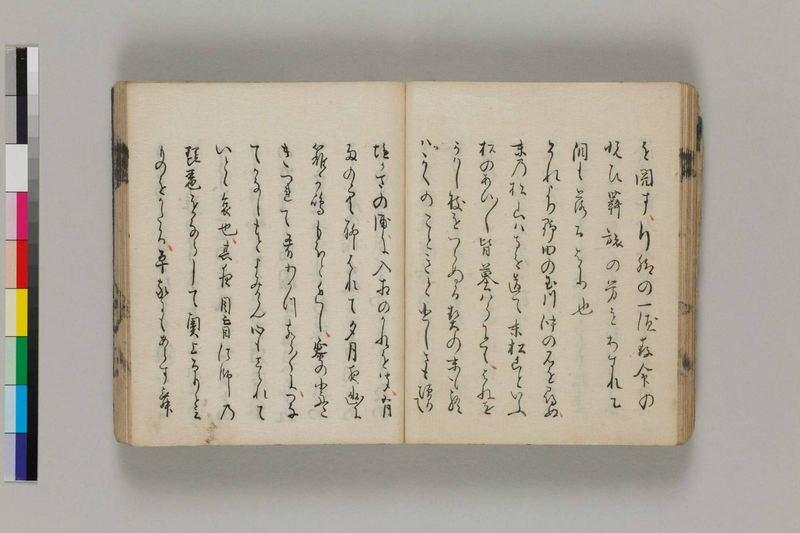
Oku no Hosomichi, 1702