Nikkō
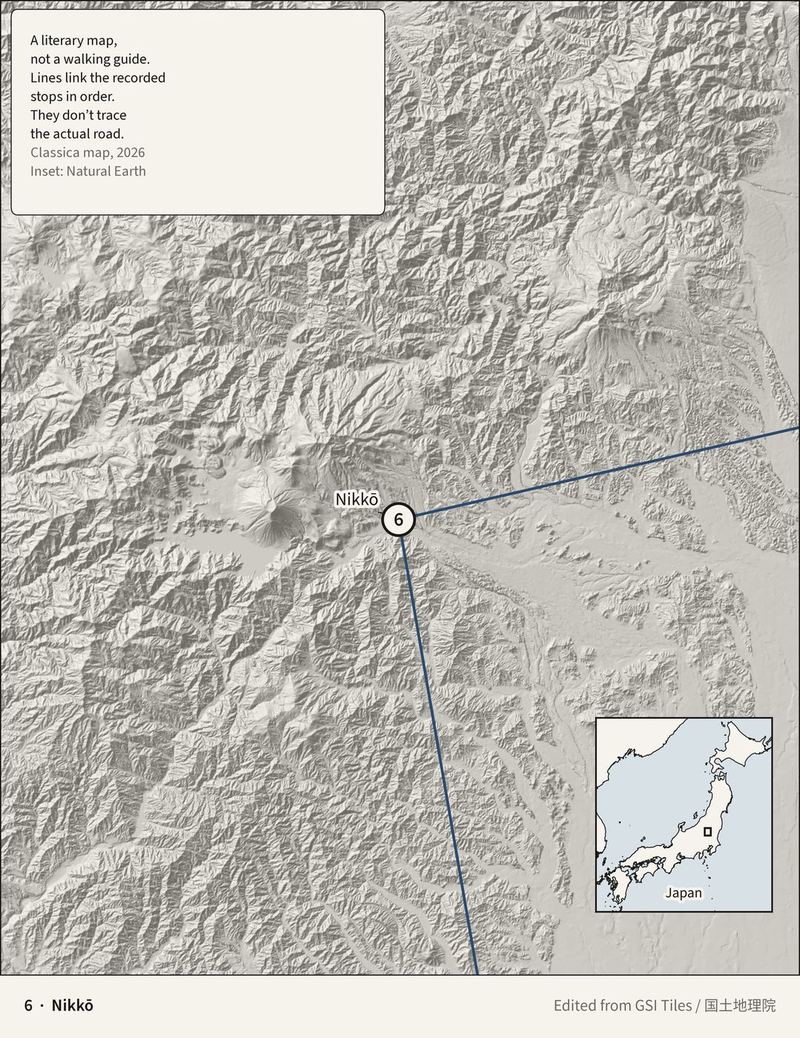
Map, Nikkō
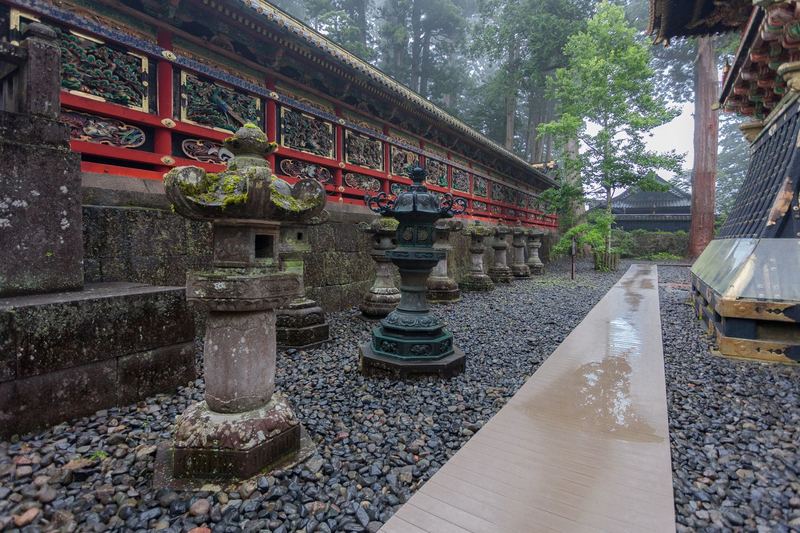
Nikkō, Tōshō-gū path
On the first day of the Fourth Month we went to worship at the holy mountain. Long ago the name of this mountain was written Futarasan; when the Great Teacher Kūkai founded the temple here, he changed it to Nikkō, “Light of the Sun.” Perhaps he foresaw what would come a thousand years later, for now this sacred light shines across the whole sky, its blessings overflow to the eight corners of the land, and the four classes of people live secure and at peace. But there is too much here to speak of without irreverence, and I lay down my brush.
Awe and reverence—sunlight on the summer greenand the leaves just born
Mount Kurokami was veiled in haze, its snow still white.
My hair shaved off—at Black Hair Mountain, summerand a change of robe— Sora
Sora’s family name is Kawai, and he went by Sōgorō. He lived beside me, his eaves next to mine beneath the leaves of my bashō plant, and helped me with the chores of firewood and water. This time he was delighted to share with me the views of Matsushima and Kisakata, and wished, besides, to ease the hardships of the road for me. So at dawn on the morning we set out, he shaved his head, put on a monk’s black robe, and changed the characters of his name—keeping the sound of Sōgo, but writing ones that mean “awakening to the Way.” That is why he wrote the poem on Black Hair Mountain. The words “change of robe” ring with real force.
A mile or more up the mountain there is a waterfall. It leaps from the top of a cavern and drops a hundred feet into a blue-green pool among a thousand rocks. You can tuck yourself into a hollow in the rock and look out at it from behind, which is why, they say, it is called Urami no Taki, the Falls Seen from Behind.
A little whilein seclusion at the falls—the summer retreat begins
Traveler’s notes
卯月朔日: the first of the Fourth Month, the day of 衣更 (koromogae), the change into summer clothes. 御山 is “the holy mountain.”
The text says the mountain, once written 二荒山 (Futarasan), was renamed 日光 (Nikkō, “Light of the Sun”) by the Great Teacher Kūkai at its founding. 日の光 in the first hokku echoes that name; 八荒 (the eight corners of the world) also plays on 二荒. Bashō then lays down his brush rather than write more of the mountain’s present glory.
あらたうと is read ara tōto (historical たうと → tōto), “how august.” 青葉若葉 (green leaves and leaves just born) is an early-summer kigo.
Sora’s 剃捨て黒髮山に衣更: 黒髮山 is Mount Kurokami, “Black Hair Mountain” in the verse, played against shaving his head. 衣更 is both the seasonal change of robe and his taking a monk’s black robe (墨染). He writes 惣五 as 宗悟 (same sound, Sōgo: “awakening to the Way”). Bashō’s prose then names the poem’s mountain 墨髮山, replacing 黒 with 墨, the ink of that robe.
暫時は is read shibaraku wa, not zanji. 夏の初 is read ge no hajime, the start of the Buddhist summer retreat (夏 as げ), not natsu no hajime, which would also overfill the last five morae.
うらみの瀧 (Urami no Taki), “the Falls Seen from Behind,” is explained in the text as a view from behind the water (裏見). A homophone 恨み, “resentment,” is often heard but is not the etymology Bashō gives. 廿餘丁 is given loosely as “a mile or more.”
Riichi’s 1778 notes
Long ago the name of this mountain was written Futarasan; when the Great Teacher Kūkai founded the temple here, he changed it to Nikkō
Kūkai is the Great Teacher Kōbō. The Genkō History of Buddhism (元亨釋書, Genkō Shakusho) says: The monk Kūkai, of the Saeki family in the world, was a man of Tado district in Sanuki. His father was Tagimi, his mother of the Ato clan. She dreamed that an Indian monk entered her bosom and she conceived; he remained in the womb twelve months and was born in the fifth year of Hōki. His mother, thinking of her dream, gave him the childhood name 貴物, “Precious Thing.” When he came of age he afterward went to the śramaṇa Gonsō and received the Dharma, and shaved his head. His first name was Kyōkai; later he himself changed it to Nyokū. In the fourteenth year of Enryaku he mounted the platform at Tōdaiji and received the full precepts, and again changed his name to Kūkai. In the twenty-second year he followed a Tang embassy into China. In the autumn, in the eighth month of the first year of Yuanhe, he returned. The retired emperor of the Daidō era entered the platform for consecration, and from this the secret consecration of emperors began. In the seventh year of Kōnin he traveled in Kishū, found a favorable site, and went up Mount Kōya, where he founded Kongōbuji. In the second year of Jōwa, Kūkai being there, on the twenty-first day of the Third Month he sat in the lotus posture and entered meditation. In the winter, in the tenth month of the twenty-fifth year of Engi, he was granted the posthumous title Great Teacher Kōbō. (A Great Teacher who is a teacher of the nation is in every case a teacher of emperors; therefore the posthumous name is conferred after death.) As for Kūkai’s being the founder of Mount Nikkō and changing the mountain’s name, I have not yet seen this in the Record of Mount Nikkō (日光山記) or in other books besides.
its blessings overflow to the eight corners of the land
“Blessing” (恩澤), in the vulgar tongue, is 〓, and means the kindness of compassion. The characters 八荒 appear in the Classic of Mountains and Seas (山海經, Shanhaijing), the Classic of Divine Marvels (神異經, Shenyi jing), the Huainanzi (淮南子), and elsewhere; 荒 means distant regions. The eight wastes are the four quarters and the four corners; in common speech, far-off places.
and the four classes of people live secure and at peace
The four classes of people are gentlemen, farmers, artisans and merchants, as seen in the History of the Former Han (前漢書, Qian Han shu), Treatise on Food and Money (食貨志, Shihuo zhi). “Secure in their lots” (安堵) is also written 案堵, and is scattered through the histories. It means the same as living at peace (安居).
Mount Kurokami was veiled in haze
The local custom names this mountain 〓. 〓 of Shimotsuke, this mountain’s common name is 〓; travelers now 〓.
and helped me with the chores of firewood and water
The History of the Jin (晋書, Jin shu), Biography of Tao Yuanming (陶淵明傳, Tao Yuanming zhuan), says: When Tao Qian was magistrate of Pengze, he did not take the burden of his household with him; he sent a helper to his son, saying, “I send this hand to aid you in the labor of firewood and water.” “Hand” (力) means a servant. “Firewood and water” (薪水) means the business of morning and evening meals and the like. Also, the World-Honored One, on Mount Dandaka (檀特山), took the sage Arāda (阿羅羅仙人) as his teacher and served him, doing such work as picking fruit and drawing water — that is the comparison being made.
This time he was delighted to share with me the views of Matsushima and Kisakata, and wished, besides, to ease the hardships of the road for me.
眺 is read nagamu; it means a view or prospect (眺望). 羈 is properly written 羇 and is read 〓; 羇 is a phonetic stand-in (假音). 羇旅 means being away on a journey, as seen in the Zuo Tradition (左傳).
It leaps from the top of a cavern and drops
“Cavern” (洞) is interchangeable with 峒, a rocky grotto. “Blue-green” (碧) is read midori in Japanese and means a lapis-lazuli color. A “deep pool” (潭) is an abyss. Because a deep place in the water is of that ruri color, it is called a blue-green pool (碧潭).
You can tuck yourself into a hollow in the rock and look out at it from behind
“Rocky hollow” (岩窟) also means a rock cave (岩屋). That is why it is called Urami no Taki, the Falls Seen from Behind.
A little while in seclusion at the falls—the summer retreat begins
“Summer” was originally “the binding of summer” (結夏); it is abbreviated to “summer.” It is the name for the season when houses of monks seclude themselves for practice. The Five Assorted Offerings (五雑組, Wuzazu) says: On the fifteenth day of the Fourth Month, monks and nuns throughout the realm hang up their staffs at houses of meditation, and this is called binding the summer. It is also called “binding the rule” (結制), and also “peaceful dwelling” (安居). The names are seen in the Essential Reader for the Śākya Clan (釋氏要覽, Shishi yaolan). When the form is still and the mind is gathered, that is called “peace” (安); to dwell here for a set term is called “dwelling” (居). 安居 means to dwell in stillness. A monk of my acquaintance, Ran’an (懶菴), says: In India the year has three seasons, spring, summer and winter, and no autumn; therefore one season corresponds to four months of China. From the fifteenth of China’s present Fourth Month to the fourteenth of the next month: the first fifteen days are called the black moon, the latter fifteen the white moon, just as in midsummer one speaks of the waxing and waning strings. “One summer of ninety days” means the days of binding the rule within a single season. It does not mean that ninety days exhaust the season.
1702 first printing
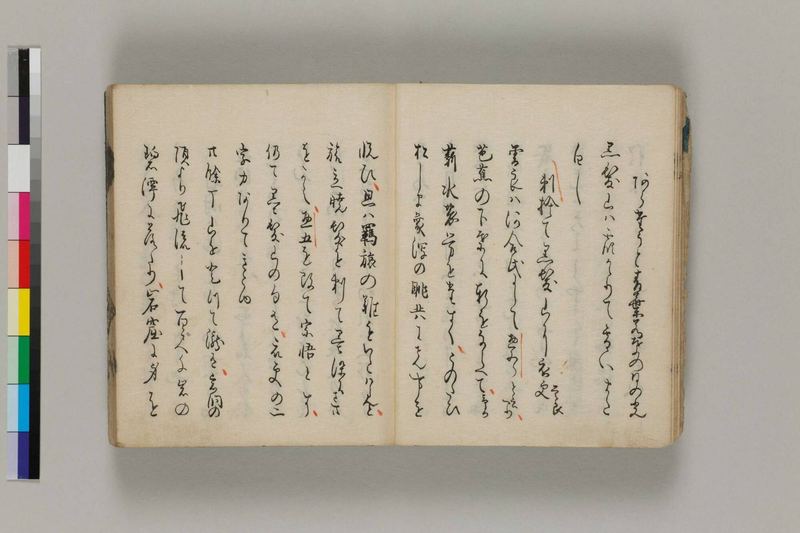
Oku no Hosomichi, 1702
Picture
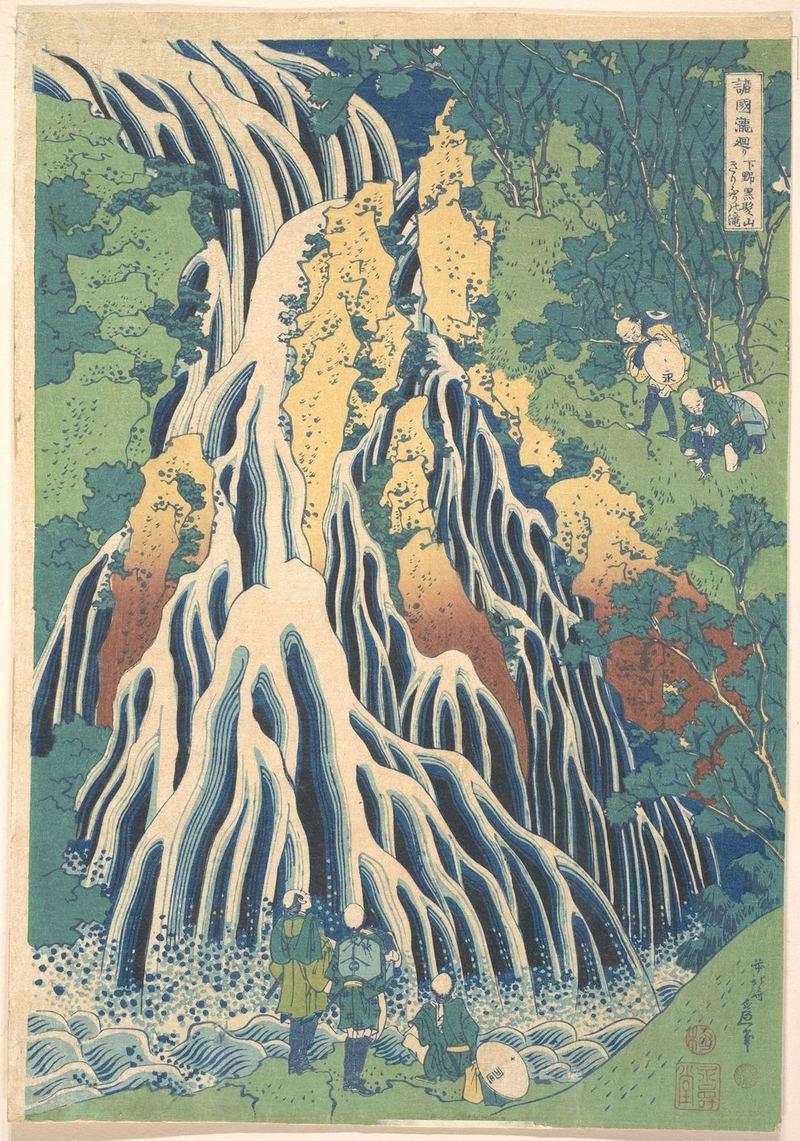
Kirifuri Waterfall, Mount Kurokami