Nasu Moor
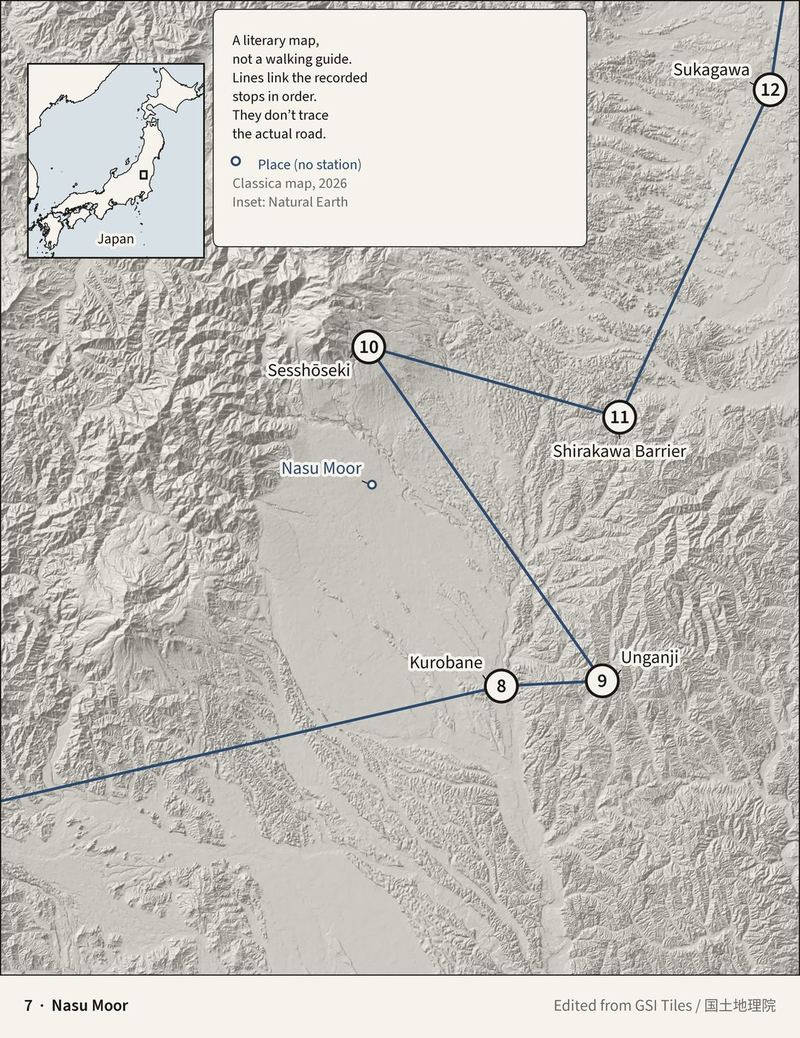
Map, Nasu Moor
I had an acquaintance at a place called Kurobane in Nasu, so from here I set out across the moor, meaning to go by the direct way. Far off we spotted a village and made for it, but rain began to fall and the day grew dark. We borrowed a farmer’s house for the night, and at daybreak we went on again across the open moor. There we came on a horse put out to graze. When I went to a man cutting grass and told him our trouble, he showed, rough countryman though he was, that he did not lack kindness. “What’s to be done?” he said. “Still, this moor splits off every which way, and a traveler who doesn’t know it could easily take a wrong turn, which worries me. Take this horse, and where it stops, send it back.” And so he lent it to us.
Two small children came running along behind the horse. One was a little girl, and her name was Kasane. It was a name I had never heard before, and so gentle that Sora wrote:
Kasane, “layers”—a fitting name, surely,for a many-petaled pink— Sora
Before long we reached a village, and we tied the fee to the saddle and sent the horse back.
Traveler’s notes
那須の黒ばね is Kurobane in Nasu (黒羽). They take the direct path across the moor (野越).
かさね (Kasane) is glossed once as “layers” (重ね). Sora’s verse ties the name to 八重撫子, a many-layered pink. 撫子 (nadeshiko) is an autumn kigo, one of the seven autumn flowers, and also suggests a beloved or gentle girl (撫でし子); here it serves the name-play, not the early-summer season of the journey.
うゐ〳〵敷 is uiuishiki, “inexperienced,” with the mark 〳〵 repeating ゐ.
The borrowed horse is sent back with the fee (あたひ) tied to the saddle once they reach a village.
1702 first printing
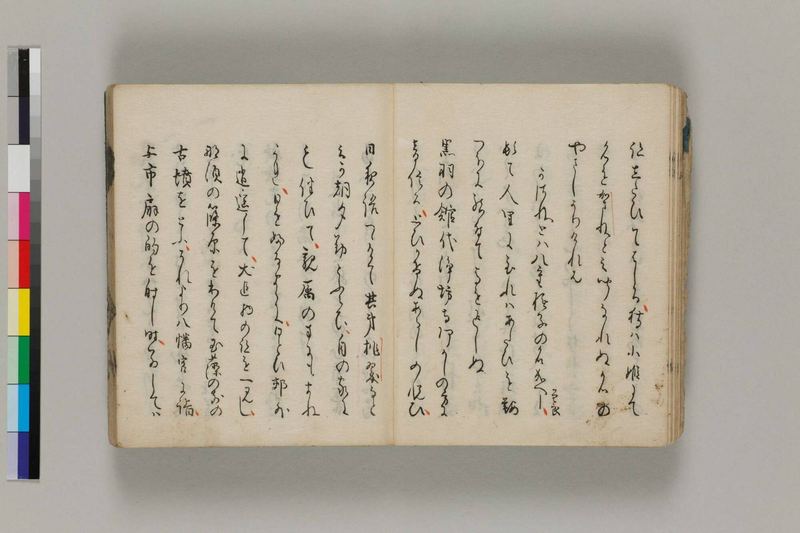
Oku no Hosomichi, 1702