Hiraizumi
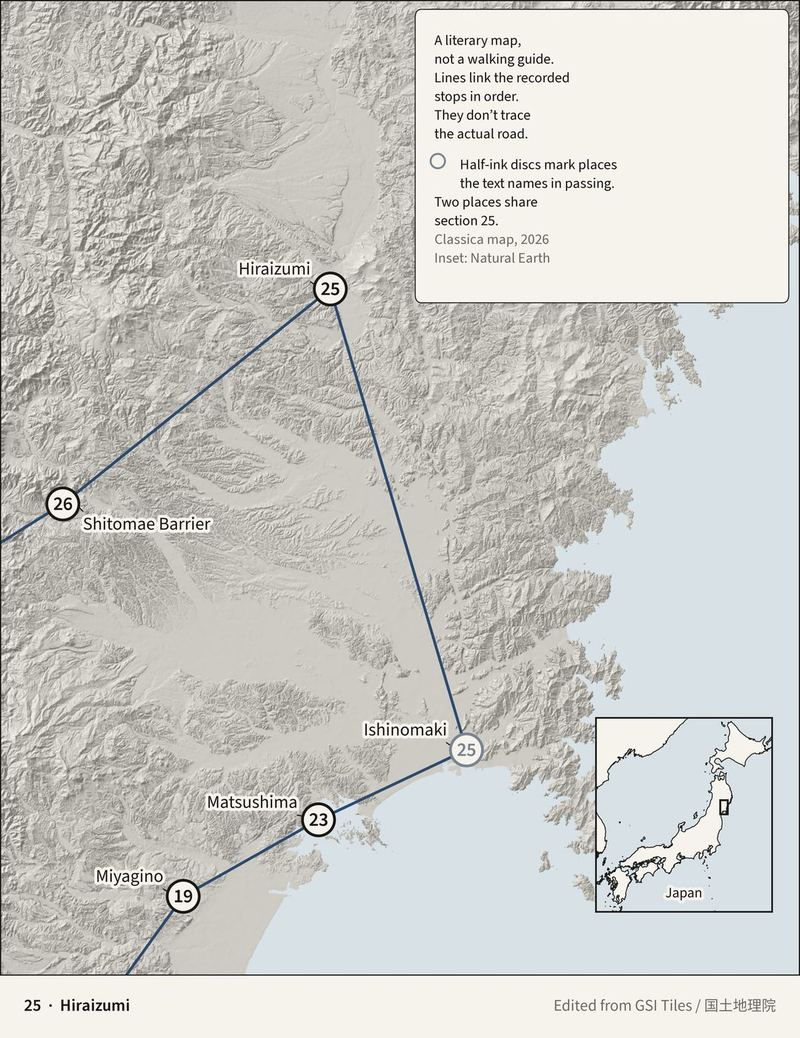
Map, Hiraizumi
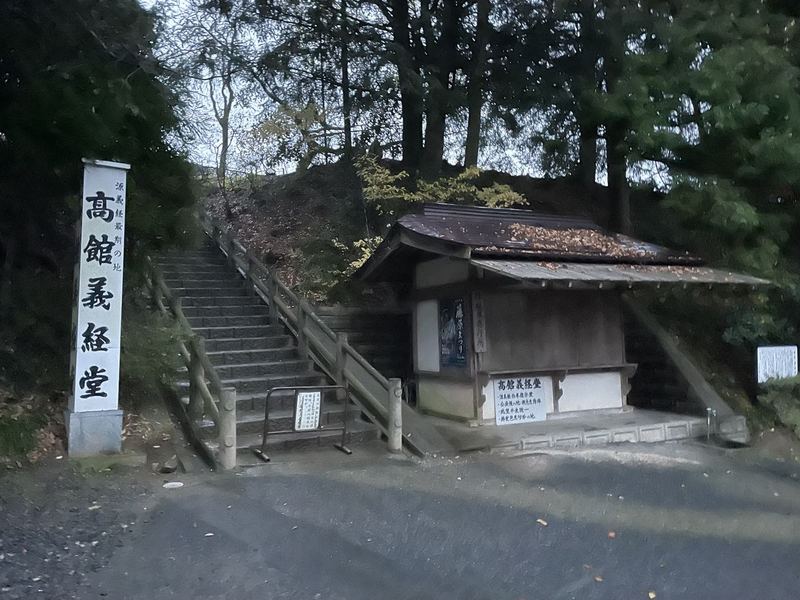
Hiraizumi, Takadachi
By the way
On the map it’s a neat hop to Hiraizumi. In fact they lost the road and ended up at the port of Ishinomaki. From there, by way of Toima, Hiraizumi was a little over twenty leagues.
On the twelfth we set out for Hiraizumi. We had heard of the Aneha Pine and the Odae Bridge, but the way was one where people seldom pass, trodden only by hunters, woodcutters, and grass-cutters, and we could not tell which it was; in the end we lost the road and came out at a port called Ishinomaki. Out across the sea we could see Kinkazan, the mountain of which it was written in a poem offered to the emperor that golden flowers bloomed there. Hundreds of cargo ships were gathered in the inlet, houses crowded one another for room, and the smoke of their hearths rose without a break. Never having thought to come to such a place, we tried to find lodging, but no one at all would take us in. At last we spent the night in a poor little house, and when day broke we wandered off again along roads we did not know. We looked from a distance at the Sode Ferry, the Obuchi pasture, and the reed plains of Mano, and went on along a long embankment. Following the lonely Naganuma marsh, we stayed a night at a place called Toima and came at last to Hiraizumi. We reckoned the distance at a little over twenty leagues.
The glory of three generations passed in the space of a single sleep, and the site of the great gate lies a league this side of the town. Hidehira’s mansion has become fields and wilderness; only Kinkeizan still keeps its shape. First we climbed up to Takadachi, and there was the Kitakami, a great river flowing down from Nanbu. The Koromo River circles Izumi’s castle and pours into the great river below Takadachi. The old seat of Yasuhira and his kin lies beyond the Koromo Barrier; it seems to have guarded the approach from Nanbu and held back the Ezo. So it was that loyal retainers, the best of them, shut themselves up in this fortress, and their fame, which lasted for a moment, is now a stretch of grass. “The realm lies broken, yet hills and rivers endure; spring comes to the castle and the grass grows green.” I spread my hat on the ground and sat, shedding tears, until I lost track of the hours.
Summer grass—of the warriors’ dreams,the trace that stays
White deutzia—in it I see Kanefusa,his hair gone white— Sora
The two halls that I had long heard of with wonder were open to view. The Sutra Hall keeps images of the three generals, and the Radiant Hall holds the coffins of the three generations and enshrines a triad of Buddhas. The seven treasures had been scattered and lost, the jeweled doors torn by the wind, the golden pillars rotted by frost and snow, and it would all have fallen to ruin and empty grass, but new walls have been put up around it on four sides and a roof laid over it to keep off wind and rain. So for a while yet it remains a memorial of a thousand years.
The Fifth-Month rains—have they fallen all aroundand spared the Radiant Hall?
Traveler’s notes
On the twelfth they set out for Hiraizumi, hoping to see the Aneha Pine and the Odae Bridge, but lose the little-travelled path and come out at Ishinomaki. Across the sea is Kinkazan (金花山), the mountain of the poem offered to the throne that “golden flowers bloom” there — usually tied to the Manyōshū celebration of gold found in Michinoku.
They pass the Sode Ferry, the Obuchi pasture, and the reed plains of Mano at a distance, follow Naganuma, stay at Toima (戸伊广), and reach Hiraizumi after a little over twenty leagues.
The glory of three generations (the Ōshū Fujiwara) passed “in the space of a single sleep” (一睡の中), an echo of the Kantan / Handan pillow-dream. Hidehira’s seat is now fields; only Kinkeizan keeps its shape. From Takadachi they see the Kitakami coming down from Nanbu; the Koromo River circles Izumi’s castle and joins it below. Yasuhira’s old seat beyond the Koromo Barrier once held back the Ezo.
Loyal retainers shut themselves in this fortress; their moment of fame is now grass. Bashō quotes Du Fu’s “Spring Prospect”: “The realm lies broken, yet hills and rivers endure; spring comes to the castle and the grass grows green” (國破れて山河あり、城春にして草青みたり).
夏草や / 兵どもが / 夢の跡: 兵 is read tsuwamono; summer grass is the kigo. The grass is the traces of the warriors’ dreams. Sora sees Kanefusa’s white hair in the white deutzia (卯の花, a summer kigo).
The Sutra Hall keeps images of the three generals; the Radiant Hall (光堂, not “Hall of Gold”) holds the three generations’ coffins and a Buddha triad. Newly walled and roofed, it still stands. 五月雨の / 降のこしてや / 光堂: have the Fifth-Month rains fallen all around and spared the Radiant Hall? 光堂 is read Hikaridō.
Riichi’s 1778 notes
On the twelfth we set out for Hiraizumi. In the end we lost the road and came out at a port called Ishinomaki. Out across the sea we could see Kinkazan, the mountain of which it was written in a poem offered to the emperor that golden flowers bloomed there.
Ishinomaki lies eight leagues northeast of Matsushima. 湊, according to the Zhengzitong (正字通), is annotated “a meeting of waters” (水會也); it means a place where people of the seacoast gather in numbers, and so in common speech now it is a name for a harbor where ships call. As for Kinkazan: in the twenty-first year of Tenpyō, in the reign of Emperor Shōmu, gold was presented from Oda district in Mutsu; the matter is seen in the Continued Chronicles of Japan (續日本紀, Shoku Nihongi) (and in connection with the Vairocana of Tōdaiji). They stayed at Toima and came to Hiraizumi.
The glory of three generations passed in the space of a single sleep.
The three generations are Kiyohira, Motohira, and Hidehira. Kiyohira’s father was Watari no Gondayū Tsunekiyo, a descendant in the sixth generation of Tawara Tōda Hidesato, and the husband of Abe no Sadatō’s sister. In the Former Nine Years’ War Tsunekiyo sided with Sadatō and died in battle. Yoriyoshi gave Tsunekiyo’s widow, together with her two-year-old son, to Takenori as wife; that boy was Kiyohira. Later Takenori’s own sons Takehira and Iehira rebelled; Kiyohira alone sided with Yoshiie and won distinction in battle. After Mutsu was pacified he was granted the six districts of Isawa, Kaga, Esashi, Iwai, Shiwa, and Iwate, and the three generations Kiyohira, Motohira, and Hidehira held the land here. A traveler dreams he becomes an emperor and reaches the height of joy; suddenly he loses the crown prince, is parted from empress and consorts, and sinks into grief — and then he wakes. The time he was asleep was only as long as it takes to cook millet. This is in Shen Jiji’s (沈既濟) Record of the World Inside a Pillow (枕中記, Zhenzhongji). Common speech calls it the Pillow of Handan (邯鄲枕). Hidehira’s former dwelling was already mentioned above. “Has become fields and wilderness” has the figuration of the ancient poem in the Selections of Refined Literature (文選, Wen xuan), “Ancient tombs are plowed into fields; pines and cypresses are broken up for firewood” (古墓犁爲田、松柏摧爲薪).
So it was that loyal retainers, the best of them, shut themselves up in this fortress.
An account of the campaign against Yoshitsune. According to one telling, Hidehira, when he lay ill and was about to die, saw that Yoritomo meant to hunt Yoshitsune down and to seize their lands as well. Yet because he himself was still alive, they had not yet been able to strike. “After I die,” he said, “Kamakura will certainly attack Yoshitsune; and then your own lives will also be in danger. When I am gone, Kunihira (the eldest son) and Yasuhira (written 康衡 on the page, the second son) should pretend to submit to Kamakura and resist the attack, and should have Yoshitsune and those of his retainers who have done distinguished service all flee to Ezo.” So he charged them, and died. Before long word came from Kamakura of a campaign against Yoshitsune, and thereupon the two sons faithfully kept their father’s dying charge, and Kunihira and Yasuhira attacked Takadachi. Tadahira killed himself in Yoshitsune’s stead and burned, so that no one could recognize his body; the retainers Kamei, Kataoka, and Benkei and their company likewise each had men die in their place, and Yoshitsune was sent to Ezo together with his close retainers. Later the brothers Kunihira and Yasuhira also perished at Yoritomo’s hands. In Ezo, Yoshitsune was called Okikurumi; later he crossed to China, changed his name to Yoshiyuki, served and became a ranked lord, and was called King Yoshiyuki. The Record of Ezo (蝦夷志, Ezo shi) says that the Ezo especially revere the gods but do not set up shrines, and that the one they worship at the place of eating and drinking is Shōgen no Tei’i Yoshitsune; in the eastern region there is a ruin where the Tei’i dwelt. The local people are most cunning and brave, and all among the Ezo fear them. When they bless their food and drink and one asks the name, they say “Hōgan”; Hōgan is what they call Okikuru, the title Tei’i among the Ezo. In the western region there is also a place-name Benkeizaki; some say the Tei’i left here and crossed the northern sea. Genbu-bō, a haikai poet of the Eastern Capital, told him that China is now ruled by the Tartars and the age is called Qing (清); they take Yoshitsune as their ancestor, and even the dynastic name takes the 清 of the Seiwa-Genji. He has heard this set down in a book compiled under the Qing, called 圖書未成. In the Qing royal capital, household after household hang Yoshitsune’s portrait at their gates. On examination, this matches what is seen in the Record of Ezo and Genbu-bō’s account: it is clearly true, he concludes, that Yoshitsune did not die at Takadachi but passed through Ezo into China.
their fame, which lasted for a moment, is now a stretch of grass.
“Fame” (功名) comes from the words of the Laozi (老子), “When the work is accomplished and the name follows, then to withdraw oneself is the Way of Heaven” (功成名遂而身退天之道). 叢, according to the Yupian (玉篇), means the appearance of growing grass. This passage has the sense of the verse “Fame and achievement [end as] a mound of earth” (功名土一丘).
“The realm lies broken, yet hills and rivers endure; spring comes to the castle and the grass grows green.” Summer grass— / of the warriors’ dreams, / the trace that stays
He takes the lines from Du Fu’s Spring Prospect (春望, Chunwang): “The nation is broken, yet mountains and rivers remain; spring comes to the castle, and plants and trees grow deep” (國破山河在、城春草木深). On examination, this passage tacitly matches, as if answering, the ancient poem in the Selections of Refined Literature: “Ancient tombs are plowed into fields; pines and cypresses are broken up for firewood; the white poplars are full of a grieving wind; rustling, they make one sick with sorrow; one longs to return to the lanes of home, but there is no way to go back” (古墓犁爲田、松柏摧爲薪、白楊多悲風、蕭蕭愁殺人、思還故里閭、欲歸道無因). Those who care about writing should take this to heart.
The Sutra Hall keeps images of the three generals, and the Radiant Hall holds the coffins of the three generations and enshrines a triad of Buddhas.
The Radiant Hall (光堂) is what is called the Golden Hall (金色堂).
The seven treasures had been scattered and lost, and it would all have fallen to ruin and empty grass; so for a while yet it remains a memorial of a thousand years.
The seven treasures, according to the Forest of Gems in the Garden of the Dharma (法苑珠林, Fayuan zhulin) citing the Long Āgama (長阿含經, Chang Ahan jing), are: first, the treasure of the golden wheel; second, the white-elephant treasure; third, the dark-blue horse treasure; fourth, the divine-pearl treasure; fifth, the jade-maiden treasure; sixth, the householder treasure; seventh, the treasure of the commander of troops. Another account takes the seven treasures to be lapis lazuli, crystal, tridacna, agate, coral, amber, and pearls. There is also a telling that drops pearls and adds gold and silver. (On examination, these two accounts may come from the Universal Gate chapter of the Lotus Sutra (法華普門品).) 頽廃 is read “crumbled and ruined”; 空虚, the two characters, is properly read munashi, empty.
1702 first printing
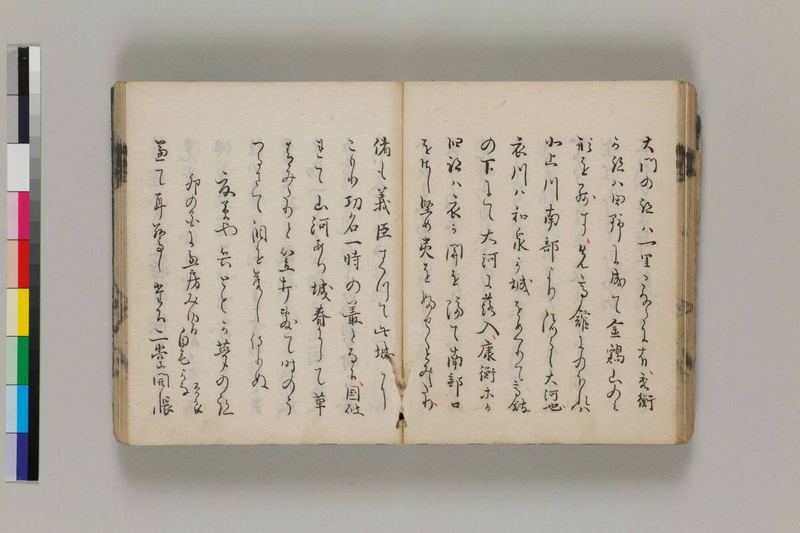
Oku no Hosomichi, 1702