Sukagawa
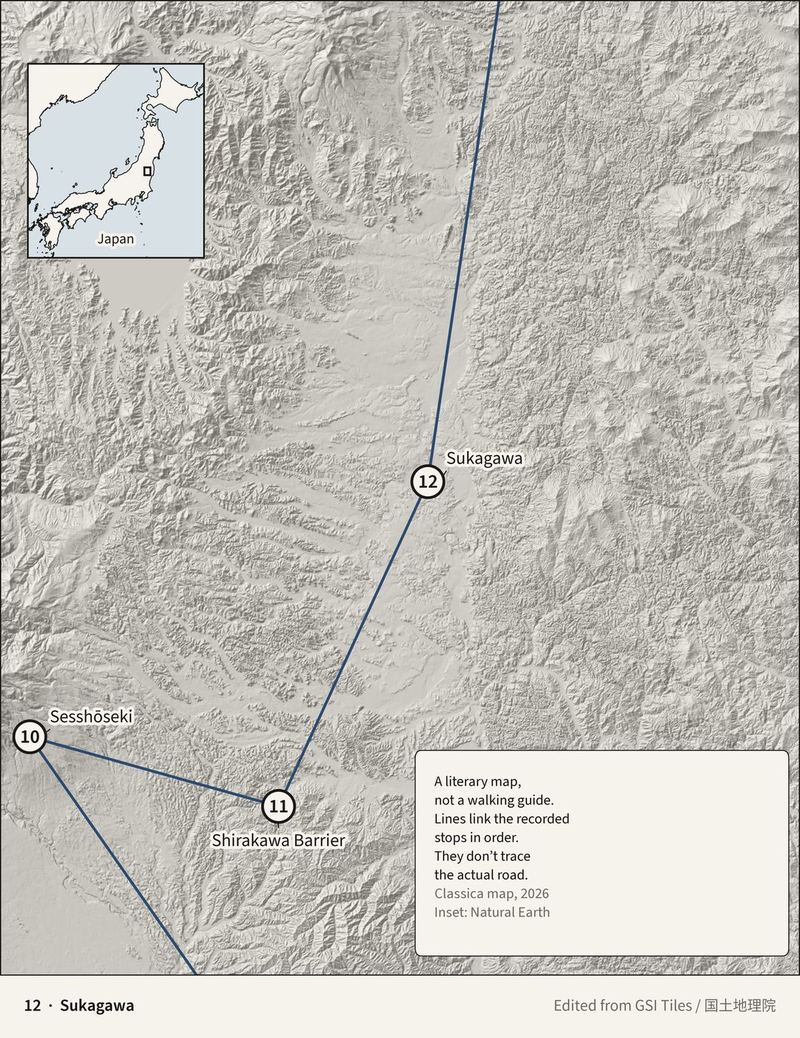
Map, Sukagawa
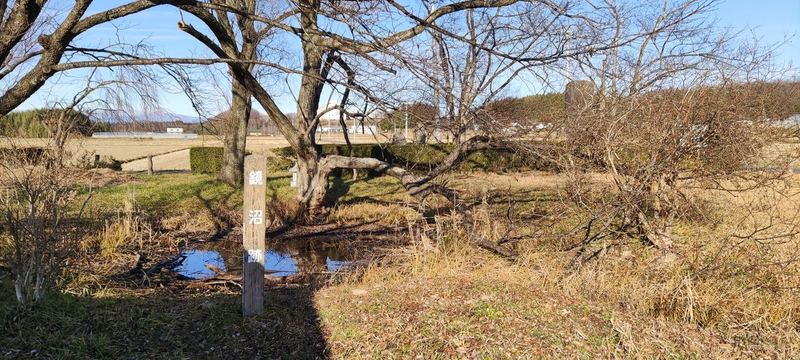
Kagenuma, Sukagawa
And so, going on as best we could, we crossed the Abukuma River. To the left the peak of Aizu rose high; to the right lay the lands of Iwaki, Sōma, and Miharu, and mountains ran on in a line marking the borders of Hitachi and Shimotsuke. We passed a place called Kagenuma, the Shadow Marsh, but the sky was overcast that day and nothing cast its reflection there.
At the post town of Sukagawa I called on a man named Tōkyū, and he kept us there four or five days. The first thing he asked was, “How did you cross the Shirakawa Barrier?” I told him that between the strain of the long road, which had worn out body and mind, and the scenery, which had stolen my soul, and the memories of old, which had torn at my heart, I had not been able to think anything through.
Where verse begins—the songs of rice-plantingin the deep north
“But it seemed a pity to cross without any verse at all,” I said, and from that we added a second verse and a third, and went on to make three sequences.
Beside this post town, in the shelter of a great chestnut tree, lived a monk who had turned his back on the world. In that quiet I wondered whether the deep mountains where one gathers horse-chestnuts might be like this, and wrote something down. These were the words:
The character for “chestnut” is written “west” and “tree,” and so it is linked to the Western Paradise; that, they say, is why the Bodhisattva Gyōki used this wood all his life for his staff and the pillars of his house.
A flower the worldpasses by without seeing—chestnut by the eaves
Traveler’s notes
あぶくま川 is the Abukuma River; 會津根 the peak of Aizu. To the right lie the lands of Iwaki, Sōma, and Miharu, with mountains marking Hitachi (常陸) and Shimotsuke (下野).
かげ沼 (Kagenuma, “the Shadow Marsh”) is named for reflections; the sky that day is overcast, so nothing is mirrored there.
すか川 is Sukagawa (須賀川). The host is 等窮 (Tōkyū). His question “how did you cross the Shirakawa Barrier?” asks for the crossing and for the verse made there.
風流の初やおくの田植うた: 風流 is poetic taste or elegance, broader than “verse”; おく is the deep north; 田植うた (rice-planting songs) is a summer kigo. They then add a second verse and a third (脇・第三) and make three sequences (三卷).
橡ひろふ太山: gathering horse-chestnuts (橡, tochi, not 栗) in the deep mountains, a stock image of eremitic life. 間に is read shizuka ni (間 standing for 閑, “in the quiet”). Specific source poem uncertain.
栗 is written 西 + 木, “west tree,” and so is tied to the Western Paradise; that, the text says, is why the Bodhisattva Gyōki used chestnut wood for staff and pillars. 世の人の見付ぬ花や軒の栗: chestnut blossom, a summer kigo, is a flower the world passes by — like the recluse under the tree.
1702 first printing
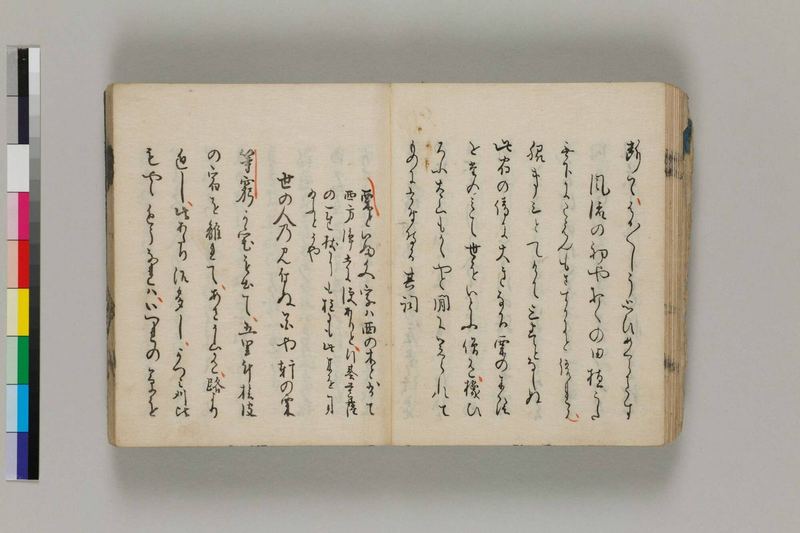
Oku no Hosomichi, 1702
Illustrated life
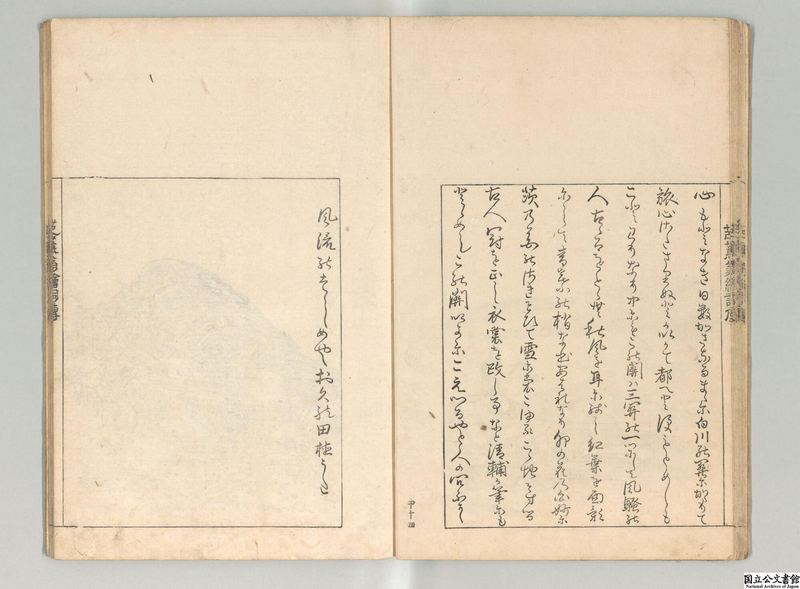
Illustrated life of Bashō, 1789–1801