The Tsubo Stone
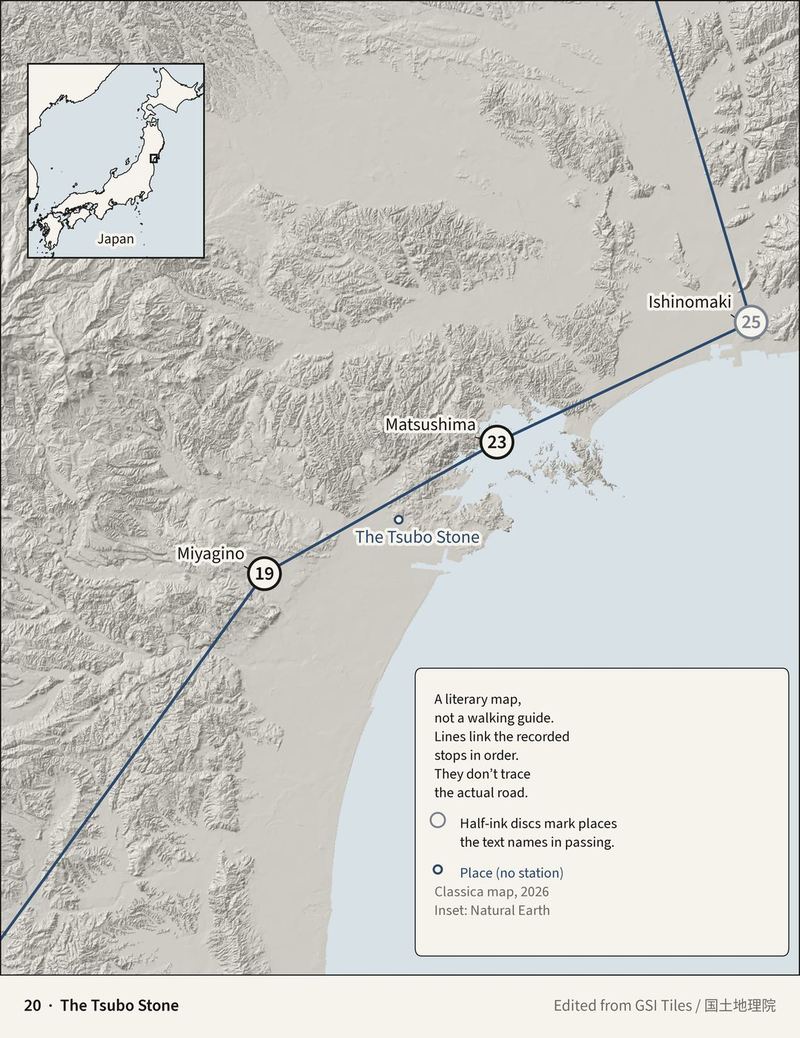
Map, The Tsubo Stone
Following his drawings, we made our way on, and at the foot of the hills along the narrow road into the deep north grew the ten-strand sedge. They say that even now, every year, mats of ten-strand sedge are woven and presented to the lord of the province.
The Tsubo Stone: at Taga Castle, in Ichikawa Village.
The Tsubo Stone stands more than six feet tall and about three feet wide. The characters, showing through the moss, are faint. It records the distances in leagues to the borders of the province in the four directions. It reads: “This castle was established in the first year of Jinki by Ōno no Azumabito, Inspector and General of the Pacification Headquarters. In the sixth year of Tenpyō Hōji it was rebuilt by Emi no Asakari, Councillor, Military Commissioner of the Tōkai and Tōsan circuits, and likewise General. The first day of the Twelfth Month.” This falls in the reign of the Emperor Shōmu.
Of the places famed in poetry since ancient times, many are still spoken of and handed down. Yet mountains crumble and rivers shift, roads take new courses, stones are buried and hidden in the earth, trees grow old and give way to young ones; time moves on, the ages change, and the traces of most of them are uncertain. But here, beyond any doubt, was a memorial a thousand years old, and before my very eyes I could look into the hearts of the people of old. This is one of the blessings of the pilgrim’s road, and the joy of being alive. I forgot the hardships of the journey, and my tears all but fell.
Traveler’s notes
Following Kaemon’s drawings they come, along “the narrow road into the deep north” (おくの細道, lowercase, echoing the title), to the ten-strand sedge (十苻の菅). Mats of it are still woven each year and presented to the lord of the province.
A headnote places the Tsubo Stone (壺の碑 / つぼの石ぶみ) at Taga Castle, in Ichikawa Village. It stands more than six shaku tall and about three wide; the characters show faintly through moss.
The inscription records distances to the provincial borders and says the castle was established in the first year of Jinki by Ōno no Azumabito, Inspector and General of the Pacification Headquarters, and rebuilt in the sixth year of Tenpyō Hōji by Emi no Asakari. The text places this in the reign of the Emperor Shōmu (the founding date, Jinki 1, falls in that reign).
Many utamakura have grown uncertain — mountains crumble, rivers shift, stones vanish, trees are replaced — but here a thousand-year memorial stands beyond doubt. Bashō calls this one of the blessings of the pilgrim’s road and the joy of being alive.
Riichi’s 1778 notes
The Tsubo Stone.
This too stands in the region of Taga Castle in Michinoku. The stele is recorded in the appendix. On examination, what people call a tsubo inside a garden courtyard should originally be the character 壺. The Erya (爾雅) says, “In the palace, a lane is called 壺” (宮中術謂之壺); that is the word. The tsubo that means a kind of jar is written 壷, and that reading is an old one. That people now call the plantings inside a gate “inside the tsubo” came about because the regular-script forms of 壺 and 壷 look alike, and in the end the Japanese readings were mistakenly treated as one.
It records the distances in leagues to the borders of the province in the four directions.
The four corners (四維) means the corners of the four directions. On examination, “a number of leagues” (數里) should be a slip of the brush for “the number of leagues” (里數). The face of the stele engraves the league-distances to the borders of the province in the four directions; see also the drawing in the appendix.
This castle was established in the first year of Jinki by Ōno no Azumabito, Inspector and General of the Pacification Headquarters. In the sixth year of Tenpyō Hōji it was rebuilt by Emi no Asakari, Councillor, Military Commissioner of the Tōkai and Tōsan circuits, and likewise General. The first day of the Twelfth Month.
These several phrases were extracted from the text of the stele. 符 is a mistake for 府; 所里 is a mistake for 所置; 獦 is a mistake for 獵, and the character 朝 has dropped out. The name of Emi no Ason is Asakari (朝獵). The matter is set out more fully on the face of the stele in the appendix.
This falls in the reign of the Emperor Shōmu.
Shōmu was the son of Emperor Monmu, the forty-fifth emperor of the human age (人皇). The title “emperor” (皇帝) arose in China with the First Emperor of Qin. (It is said that later ages took it in the sense of “sovereign.”)
Yet mountains crumble and rivers shift, roads take new courses, stones are buried and hidden in the earth, trees grow old and give way to young ones.
It has the feeling of Li Bai’s “Difficult Roads in Shu” (蜀道難, Shudao nan) in the Earlier Collection of Ancient Prose (古文前集, Kobun zenshū), “The earth split, the mountains collapsed, and the brave men died” (地崩山摧壯士死), and of the ancient poem in the Selections of Refined Literature (文選, Wen xuan), “Ancient tombs are plowed into fields; pines and cypresses are broken up for firewood” (古墓犁爲田、松柏摧爲薪).
here, beyond any doubt, was a memorial a thousand years old
“Memorial” (記念) is commonly read katami, a keepsake. It means something that stays well in the heart and is dwelt upon (念).
and before my very eyes I could look into the hearts of the people of old.
閲, the character dictionaries say, means to look through in turn (歴觀). It is to cast one’s eye around (見めぐらす).
This is one of the blessings of the pilgrim’s road, and the joy of being alive. I forgot the hardships of the journey, and my tears all but fell.
The explanations of “pilgrim’s road” (行脚) and “travel” (羇旅) were all given earlier. 存 means to be present now (見在); “still being alive” (存命) means that one’s life is still there. Forgetting the hardships of travel has the manner of the verse “In what one enjoys, one naturally forgets fatigue” (所樂自忘疲).
1702 first printing
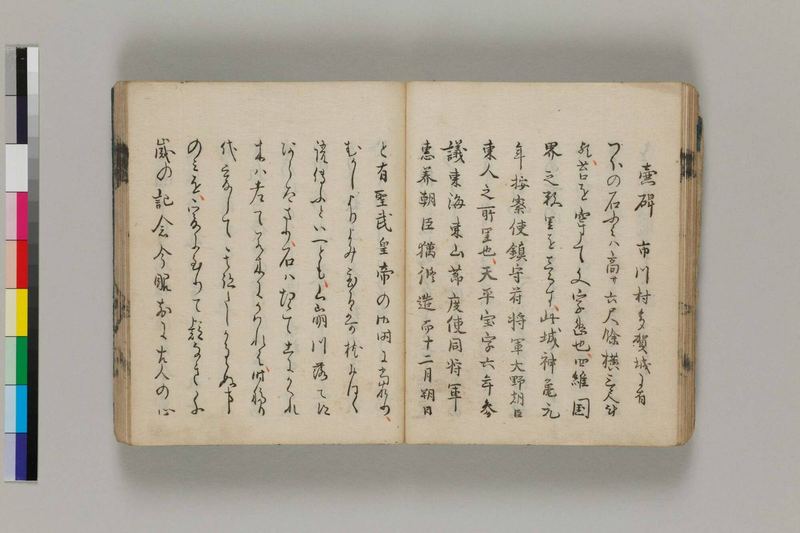
Oku no Hosomichi, 1702
1778 commentary
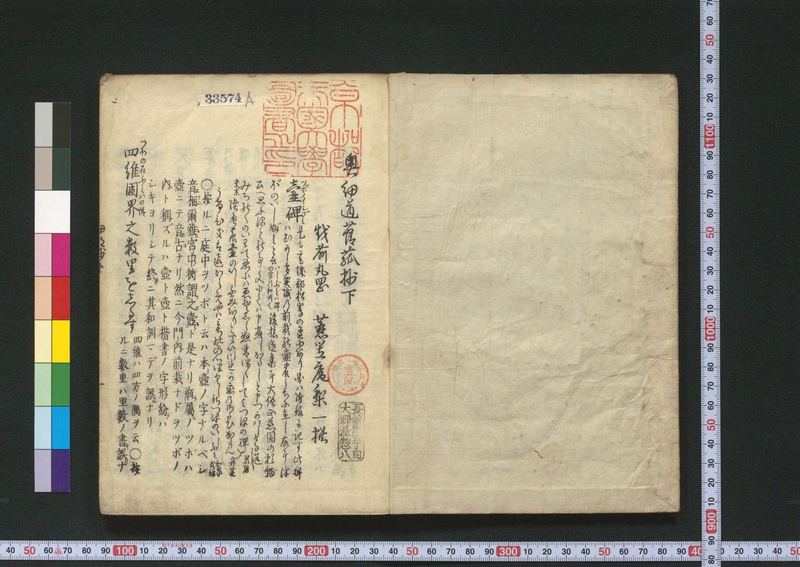
奥細道菅菰抄, 1778