Prologue
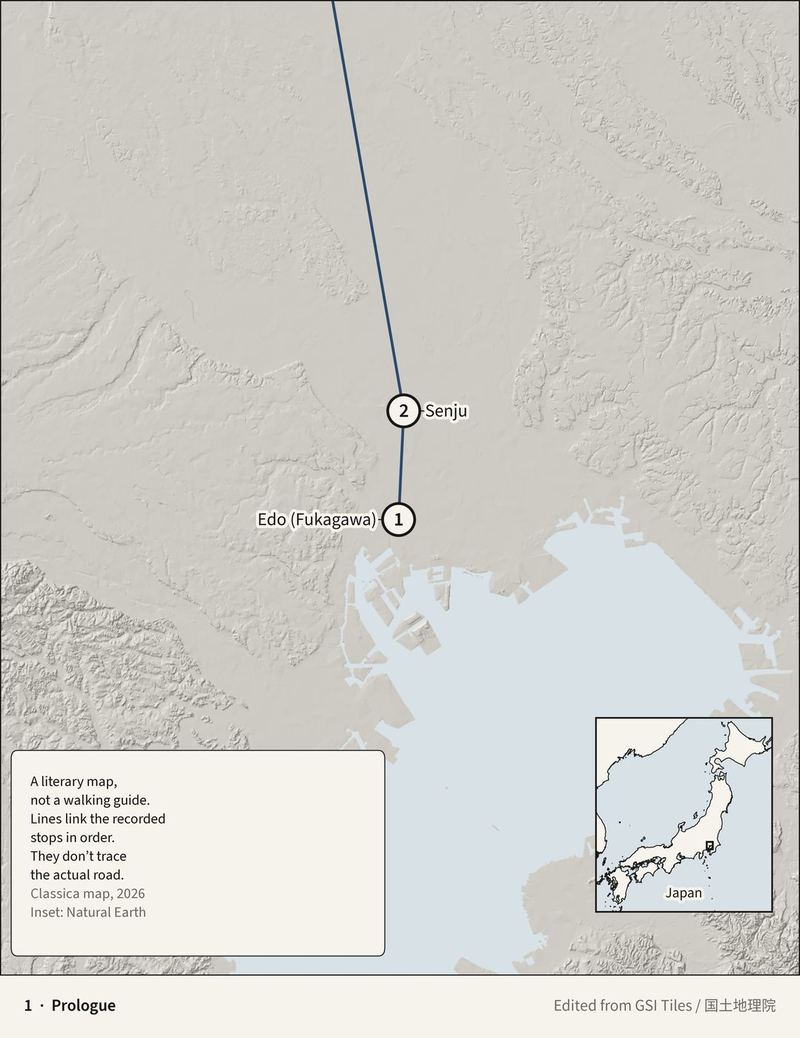
Map, Prologue
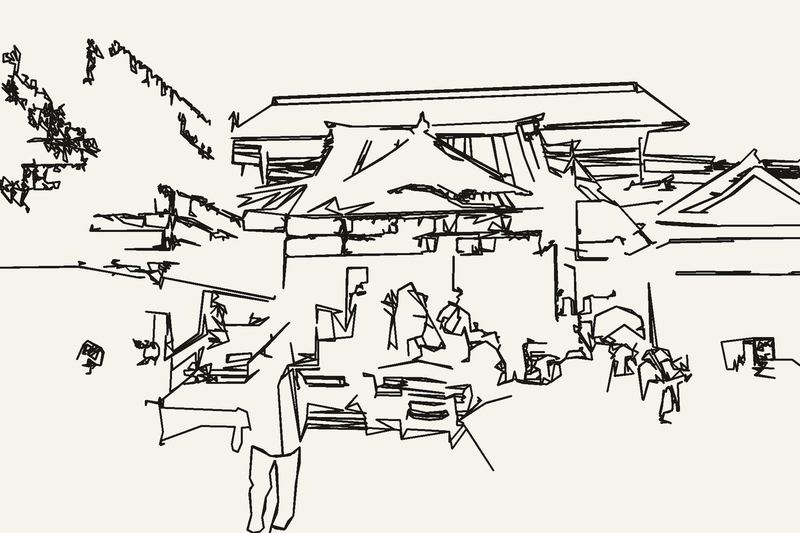
Fukagawa
The months and days are guests passing through the centuries, and the years that come and go are travelers as well. For those who spend their lives afloat on boats, or meet old age leading a horse by the bridle, every day is a journey, and the journey itself is home. Many of the ancients died on the road. I too, since some year or other, have been drawn along like a wisp of cloud on the wind, unable to shake off the urge to wander. I roamed the seacoast, and last autumn, back in my tumbledown hut by the river, I swept away the old cobwebs. Then, as the year drew to its close and spring rose into the hazy sky, I longed to cross the Shirakawa Barrier. The god of restlessness took hold of me and set my heart spinning; the gods of the road beckoned, and I could not keep my hands on anything. I patched the rips in my leggings, fitted a new cord to my hat, and burned moxa below my knees, and from then on the moon over Matsushima was the first thing on my mind. I handed my house over to others and moved to Sanpū’s cottage.
The thatched door, too,has turned to a new household—festival dolls inside
I hung the first eight verses of a linked sequence on a pillar of the old hut.
Traveler’s notes
The first sentence adapts Li Bai’s preface to a spring night banquet in a peach garden: heaven and earth are an inn, and light and shadow are travelers through a hundred generations. Bashō adds that the years themselves are travelers too.
そゞろ神 is Bashō’s “god of restlessness”; 道祖神 (dōsojin) are the gods of the road. 三里に灸 is moxa burned at the sanri point below the knee, a traveler’s precaution.
白川の關 (Shirakawa Barrier) is the poetic gate into the deep north; 松嶋 is Matsushima. 杉風 (Sanpū) is the patron whose cottage (別墅) he moves to.
ひなの家: hina dolls, a spring kigo (Third Month). They mark that a family with children has taken the hut. 住替る is read sumikawaru (the occupants change), not sumikaeru (to move house).
面八句: the first eight verses of a linked-verse sequence, hung on a pillar of the hut as a farewell.
“Many of the ancients died on the road” is generally taken to include poet-travelers such as Saigyō, Sōgi, Li Bai, and Du Fu; the text does not name them.
Riichi’s 1778 notes
The months and days are guests passing through the centuries, and the years that come and go are travelers as well.
This is taken from the Preface to a Spring Night Banquet in a Peach and Plum Garden (春夜宴桃李園序, Chunye yan taoli yuan xu) in the Later Collection of Ancient Prose (古文後集, Kobun kōshū): “Heaven and earth are the inn of the ten thousand things; light and shadow are travelers through a hundred generations.” (The turning of heaven and earth, and the path of the sun and moon, are likened to a journey.) “Inn” (逆旅) means a lodging house; “light and shadow” means the shifting of the sunlight; “passing travelers” means people on the road.
For those who spend their lives afloat on boats
“Life-span” (生涯) is what ordinary speech calls a single lifetime. It is like the Zhuangzi (荘子): “Our life has a bound” (吾生也有涯).
Many of the ancients died on the road.
Up to this point the words are the lead-in that opens the preface.
I too, since some year or other
From here the main seat of the work begins.
have been drawn along like a wisp of cloud on the wind
It has the feeling of the verse “A single wisp of lone cloud, driven flying on the wind” (一片孤雲逐吹飛).
unable to shake off the urge to wander
Both characters of 漂泊 are read tayou, to drift. It means to roam about.
I roamed the seacoast
This should be written as “a journey to compose” (吟行). Here too it means to wander. The word is found in “The Fisherman’s Discourse” (漁父辭, Yufuci) in the Selections of Refined Literature (文選, Wen xuan). It does not mean banishment.
my tumbledown hut by the river
“On the river” (江上) is like saying “the river capital” (江都) and the like; it points to Edo. (It is the Bashō school’s tumbledown hut at the place called the Asakusa River.)
as spring rose into the hazy sky
That the mountains too come into haze is the bloom of the human heart.
I longed to cross the Shirakawa Barrier
He yearns after a famous place whose name has long since entered the rolls.
The god of restlessness took hold of me and set my heart spinning
People have come to read the character 坐 as sozoro; but here one should use the characters 倉卒, “haste and agitation.” The “god” is a metaphor for the restlessness of the heart. “Ancestor” (祖) is the name of a roadside rite, the sacrifice made at the setting-out. A woman called Leizu (累祖), sister of the Yellow Emperor, loved distant travel and at last died on the road; for that she was made the god of the fork (岐神). In Japan, Sarutahiko no Mikoto is the god of the crossroads (衢神). In the age of the gods, when the heavenly princeling Ninigi (天津彦彦火瓊瓊杵尊) descended to the earth below, this was the deity who came to meet and guide him; the Chronicles of Japan (日本紀, Nihongi) give the matter in full. In later ages Buddhists attached the figure to Shōmen Kongō (青面金剛) and called it Kōshin (庚申). The Kōshin images set up along the roads are also treated as gods of the wayside (ちまたの神).
the moon over Matsushima was the first thing on my mind
Matsushima is the foremost famous place of the far north-east.
moved to Sanpū’s cottage
A “separate villa” (別墅) is the same as a detached residence (別荘); in common speech it is a lower estate (下屋敷). The History of the Jin (晋書, Jin shu), in the Biography of Xie An (謝安傳, Xie An zhuan), speaks of a garden villa; that is the word. This villa stood in Fukagawa in the Eastern Capital. Sanpū was a fish wholesaler, and lived in Odawara-chō in the Eastern Capital. The sense is that this passage serves as a preface.
The thatched door, too, / has turned to a new household— / festival dolls inside
Around the Third Month, near the Jōshi festival, when the dolls are hung. When the master of the house changes, things pass from one pair of hands to the other — east giving way to west — and that is what moves us. The playthings of the honored dolls are many; some verse speaks of their being packed into a single box, or of the large and small furnishings being put away. The heart of the lines “Year after year the flowers look alike; year after year the people are not the same” (年年歳歳花相似、歳歳年年人不同) is here.
I hung the first eight verses of a linked sequence on a pillar of the old hut.
A blessing upon the life that will be placed there. This is the opening of The Narrow Road to the Deep North.
1702 first printing
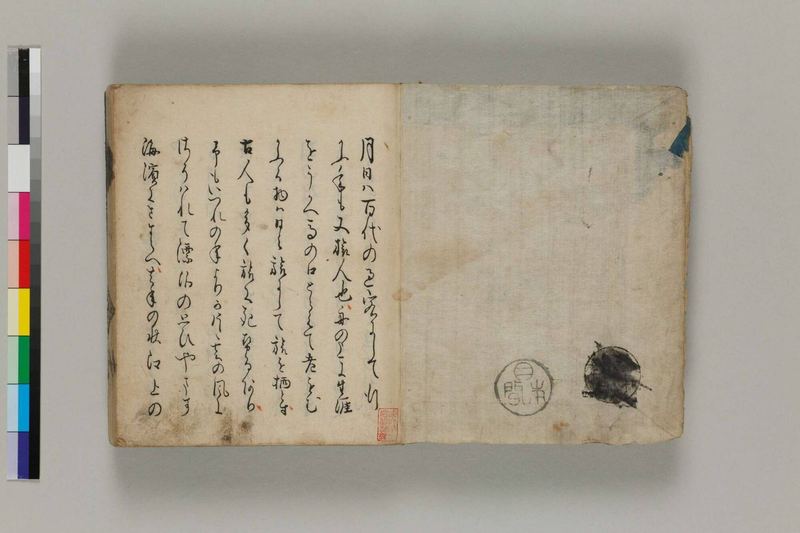
Oku no Hosomichi, 1702
1778 commentary
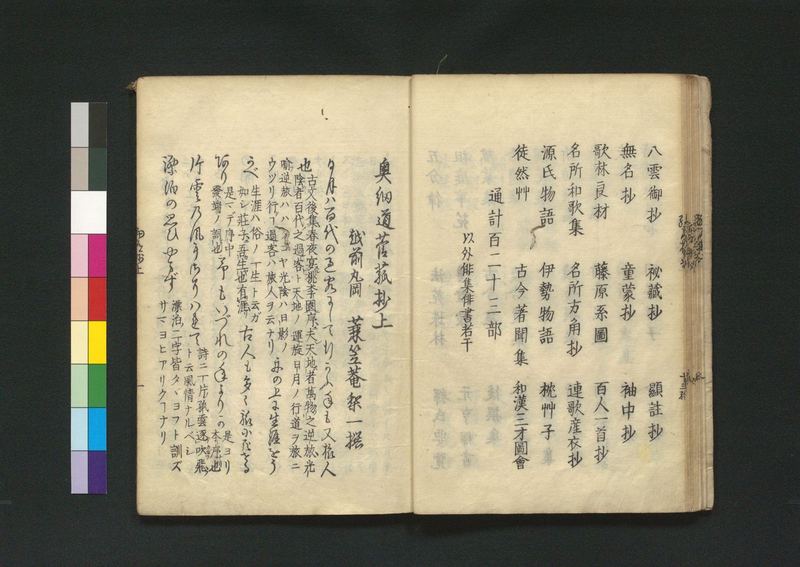
奥細道菅菰抄, 1778
Illustrated life
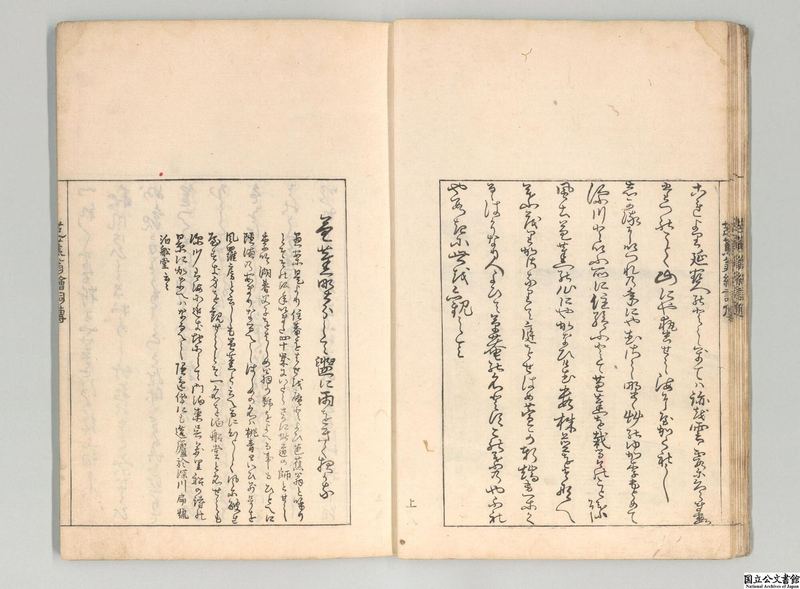
Illustrated life of Bashō, 1789–1801