Nata
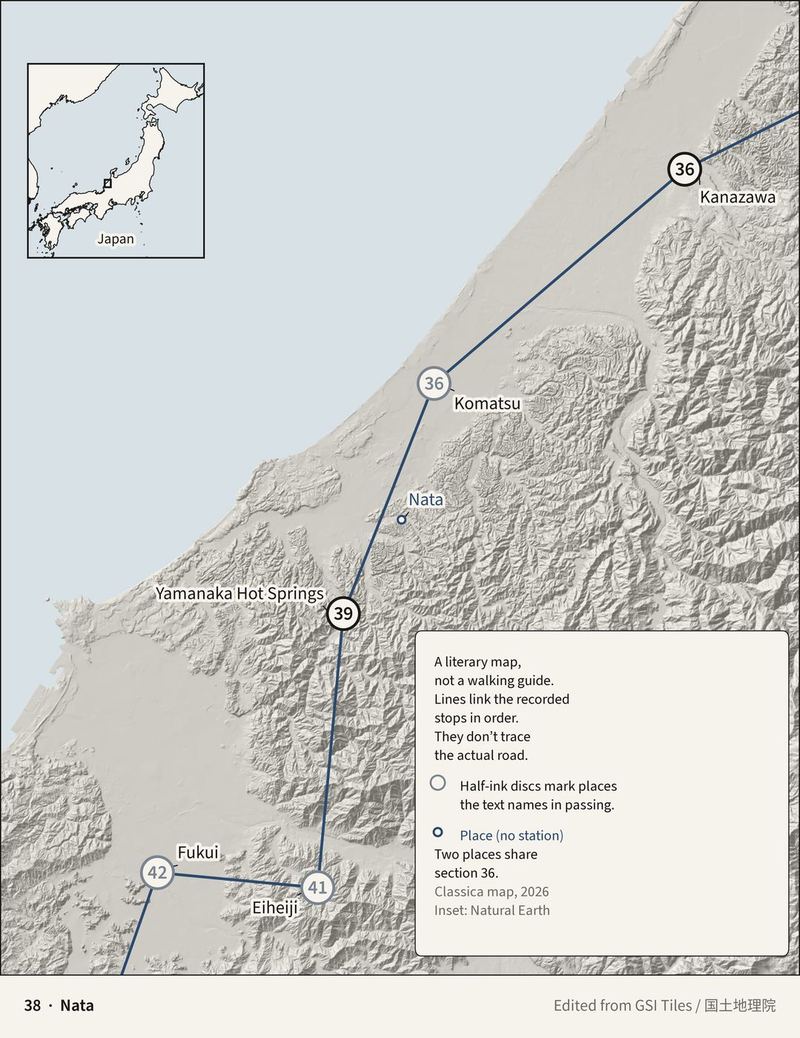
Map, Nata
On the way to the hot springs at Yamanaka, we walked with the peak of Shirane at our backs. At the foot of the mountains on the left stands a hall of Kannon. They say that after the Cloistered Emperor Kazan completed his pilgrimage to the Thirty-Three Places, he enshrined here an image of the Bodhisattva of great mercy and great compassion and named the place Nata, taking one character each from Nachi and Tanigumi. Strange rocks of every shape are set among rows of old pines, and a little thatched hall is built out over the rock. It is a holy and moving place.
Whiter stillthan the rocks of Ishiyama—this autumn wind
Traveler’s notes
On the way to the hot springs at Yamanaka they walk with the peak of Shirane at their backs. At the foot of the mountains on the left stands a hall of Kannon.
After the Cloistered Emperor Kazan (花山の法皇) finished the pilgrimage to the Thirty-Three Places, he enshrined an image of great mercy here and named the place Nata (那谷), splitting the two characters of Nachi and Tanigumi (那智谷組). Strange rocks and old pines, and a little thatched hall built out over the rock.
石山の / 石より白し / 秋の風: the autumn wind is whiter than the stones of Ishiyama. Ishiyama is left bare, as a place-name, not expanded into a temple title. 白し is the classical shiroshi.
Riichi’s 1778 notes
On the way to the hot springs at Yamanaka, we walked with the peak of Shirane at our backs. At the foot of the mountains on the left stands a hall of Kannon. … He named the place Nata 〓. … Hakusan 〓. In the second year of Reiki, in the reign of Empress Genshō, the Gongen of Hakusan appeared. The mountain was founded by the Great Teacher Taichō (泰澄大師). … The Cloistered Emperor Kazan 〓. The Genkō History of Buddhism (元亨釋書, Genkō Shakusho) says 〓. The Illustrated Compendium of the Three Powers, Japanese and Chinese (和漢三才圖會) says that the Kazan-in emperor 〓 on the night of the twenty-second day of the Sixth Month of the second year of Kanna slipped out of the palace in secret 〓. … ○ In my view, the cloistered emperor’s pilgrimage is not recorded in the histories. … Nachi and Tanigumi 〓 the Thirty-Three Places 〓. On the seventeenth day of the Third Month of the first year of Chōtoku he worshipped at Kumano, and on the first day of the Sixth Month he reached Tanigumi; this is taken as the beginning of that pilgrimage. … The name Nata (那谷) takes one character each from Nachi (那智) and Tanigumi (谷汲) 〓. …
Whiter still
than the rocks of Ishiyama—
this autumn wind
Ishiyama is Ishiyamadera in Ōmi 〓. The rocks come from this mountain 〓.
1702 first printing
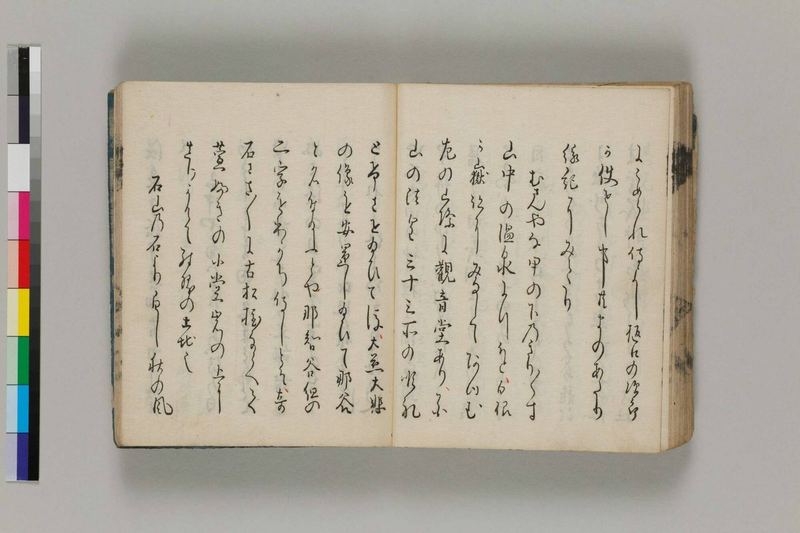
Oku no Hosomichi, 1702